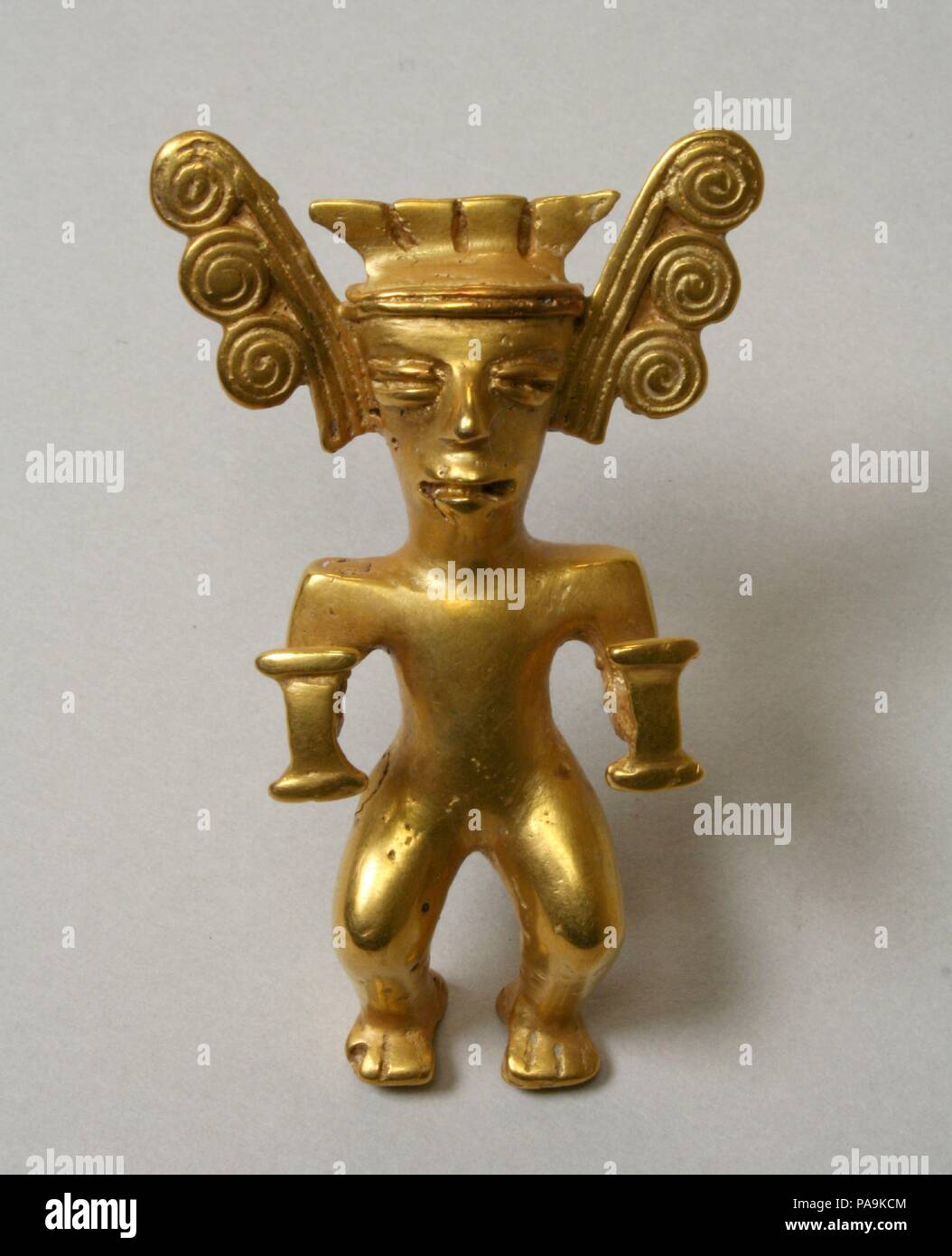
Abbildung Anhänger. Kultur: Zentrale Karibik (Costa Rica) oder Größer Chiriquí. Abmessungen: H.2 1/2x W. 1 1/2 x 5/8 in. D. (6,4 x 3,8 x 1,6 cm). Datum: A.D. 6. und 16. Jahrhunderts. Metallarbeiter in der Zentralamerikanischen Isthmus machte diese Abbildung Anhänger durch Gießen eine Legierung aus Gold durch die verloren - Wachs. Eine dicke, horizontalen Schlaufe auf der Rückseite der Abbildung Kopf deutet darauf hin, dass es von einer Person getragen werden können, aber ohne archäologischen Kontext, ist es schwierig, zu suggerieren, die es trug oder in welcher Einstellung. Leute können verteilt haben und solche Objekte für ihre Leistung zu erzeugen oder zu verstärken angezeigt
Dieses Bild kann kleinere Mängel aufweisen, da es sich um ein historisches Bild oder ein Reportagebild handel
Figure Pendant. Culture: Central Caribbean (Costa Rica) or Greater Chiriquí. Dimensions: H. 2 1/2 x W. 1 1/2 x D. 5/8 in. (6.4 x 3.8 x 1.6 cm). Date: A.D. 6th-16th century. Metalworkers in the Central American Isthmus made this figure pendant by casting an alloy of gold through the lost-wax process. A thick, horizontal loop on the back of the figure's head suggests that it could have been worn by a person, but without archaeological context, it is difficult to suggest who wore it or in what setting. People may have circulated and displayed such objects to produce or reinforce power for their clan, or group of specialists (Ibarra 2003; also see Bozzoli 1975). These gold objects would have been accessible to a wide array of people and not concentrated in the hands of a select few. The present figure wears a headdress that includes a trapezoidal element at center, a double band lower at center, and spiral-ended plumes that extend from either side of the head and out above it. The eyes and mouth are partially or completely closed, and there is a triangular nose between them. The arms of the figure are bent and project forward. Each hand holds a vertical instrument shaped like a bar with flaring ends. The figure's knees are also bent and extend in front of the feet. The figure does not stand upright on its own due to the position of the feet, which angle slightly upward at back. Metalworkers cast this object in one piece by using a ceramic core in order to give the object its depth. This core, which was removed after casting, once occupied the cavity visible on the figure's reverse. The metalworkers built a wax model around this core and then added ceramic investment around the model. This investment would have come in contact with the core. (For more information on lost-wax casting, please see Metropolitan Museum of Art 1974.271.48). Working with wax was fundamental to fabricating this figure. The artists shaped individual threads of wax to form the spiral-ended