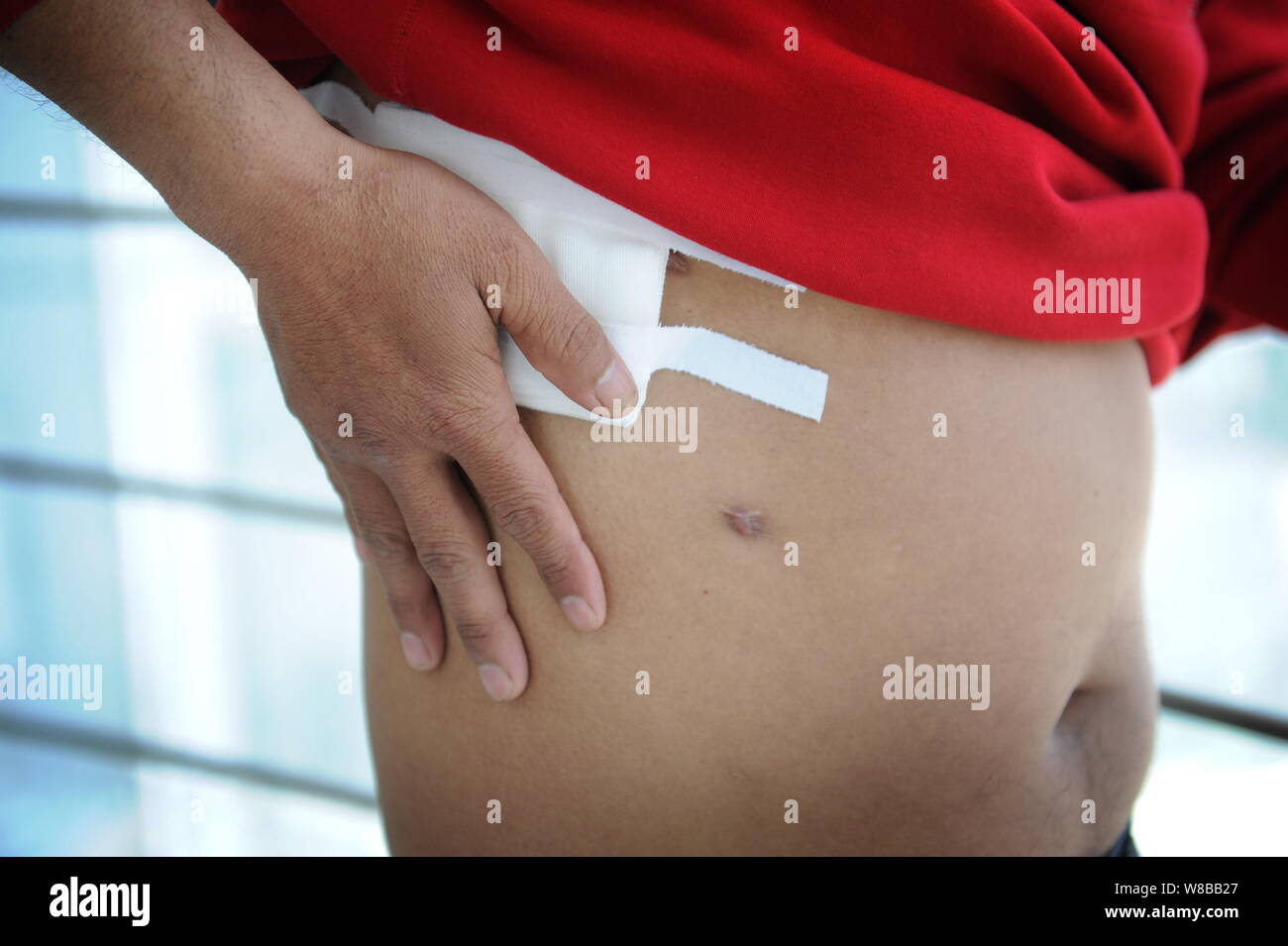
Chinesen Liu Yongwei, entdeckte seine rechte Niere gegangen war fehlt, nachdem er eine Brust Chirurgie in Xuzhou Medical School Krankenhaus zuletzt empfangenen Jun
Chinese man Liu Yongwei, who discovered his right kidney had gone missing after he received a chest surgery in Xuzhou Medical School Hospital last June, shows his wound at home in Suzhou city, east China's Anhui province, 19 April 2016. Liu Yongwei discovered during one fateful trip to a hospital in Shandong that his right kidney had mysteriously gone missing, while his left one was in serious distress, sparking an epic journey to find out what had happened to him. NetEase reports that Liu's troubles all began on the morning of June 12, 2015. It was a normal day, except for the fact that during his morning drive to work on his tractor, he happened to come across a couple of young men riding motorcycles, speeding headlong towards him, on course for what would have surely been a nasty collision. Desperate, Liu did the only thing a driver could do at the last moment; he swerved, and in doing so was thrown to the ground as his tractor flipped over. Liu was rushed to the nearby Suzhou Medical School Hospital, where he was examined by one Doctor Hu Bo. Upon examination, Dr. Hu realized that Liu had suffered significant trauma to the right side of his body, and was diagnosed with broken ribs and bruises to his liver and right kidney. Having decided that Liu had suffered enough damage to warrant a surgery, Hu immediately decided to operate, whereupon after cutting Liu open and treating his insides, Hu briefly removed the man's kidney to examine it. Hu, who is a cardio-thoracic specialist, decided that his kidney looked fine and supposedly replaced it back into the unconscious Liu. After Liu regained consciousness, he was reassured by Dr. Hu and the hospital that all was well, and that he should head on over to another hospital for further treatment. After having Liu undergo a routine CT scan, they made a couple of rather alarming discoveries: First, the surgical tubing from the first surgery was still very much embedded in the man's abdominal cavity, and now appeared to b