2300 x 3067 px | 19,5 x 26 cm | 7,7 x 10,2 inches | 300dpi
Aufnahmedatum:
11. Juli 2015
Ort:
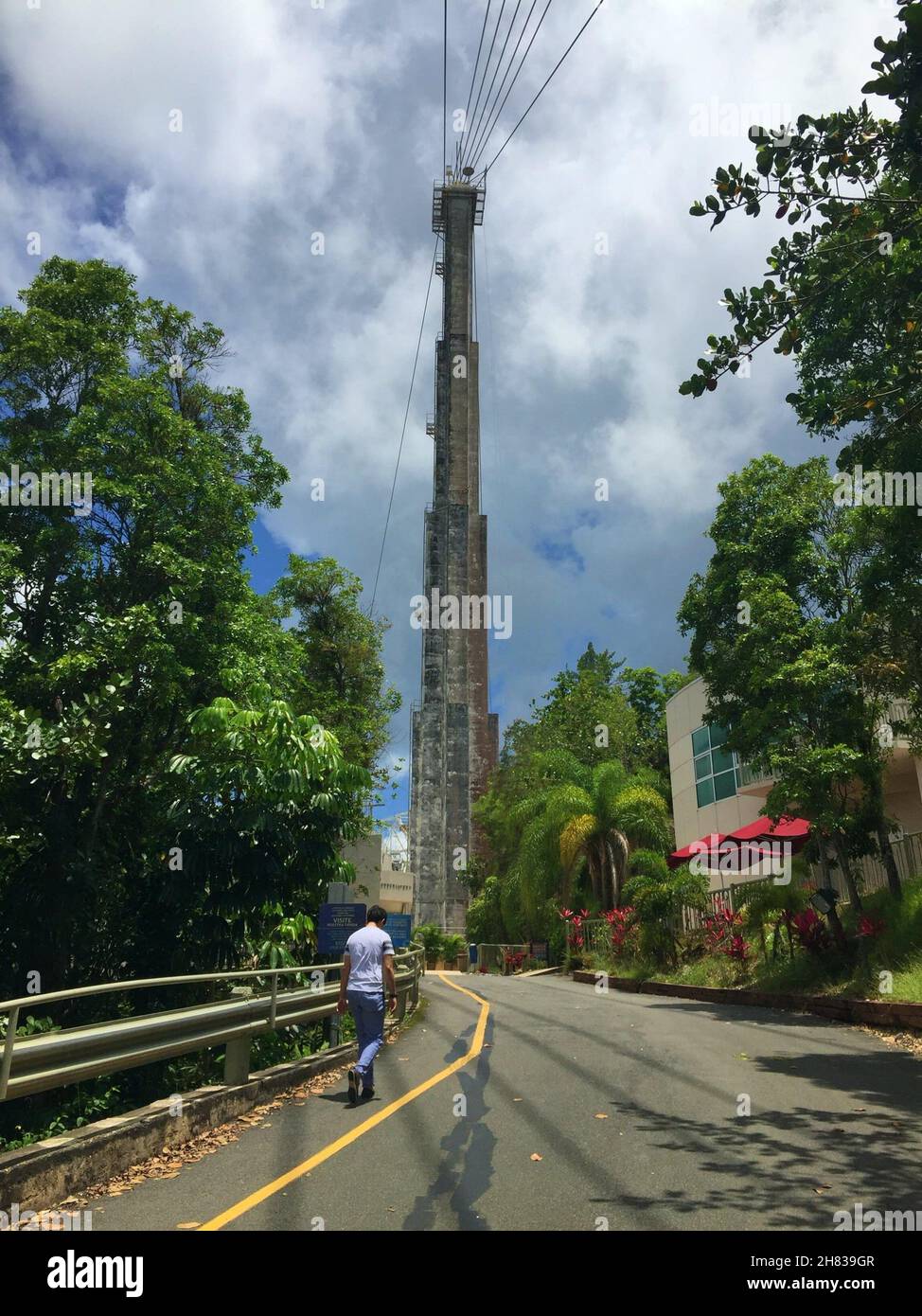
Arecibo, Porto Rico
Weitere Informationen:
The Arecibo Radio Telescope or Arecibo Telescope or Arecibo Observatory was a 305 m (1000 ft) spherical reflecting radio telescope built in a natural sink at the Arecibo Observatory located near Arecibo, Puerto Rico. A cable-mounted steerable receiver and several radar transmitters to emit signals were mounted 150 m (492 ft) above the dish. Completed in November 1963, the Arecibo Telescope was the world's largest single-aperture telescope for 53 years, before being surpassed in July 2016 by the Five Hundred-Meter Aperture Spherical Telescope (FAST) in Guizhou, China. The Arecibo Telescope was used primarily for research in radio astronomy, atmospheric science and radar astronomy, as well as for extraterrestrial intelligence search (SETI) programs. Scientists wishing to use the observatory submitted proposals that were evaluated by independent scientific referees. NASA also used the telescope for programs to detect near-Earth objects. The observatory, funded primarily by the National Science Foundation (NSF) with partial NASA support, was administered by Cornell University from its completion in 1963 until 2011, after which it was transferred to a partnership led by SRI International. In 2018, a consortium led by the University of Central Florida took over the operation of the facility. The telescope's unique and futuristic design has led to numerous appearances in film, game, and television productions, such as the climactic fight scene in the James Bond film GoldenEye (1995). It has been listed on the US National Register of Historic Places since 2008. The center has been named a landmark. Since 2006, the NSF has reduced its funding commitment to the observatory, prompting academics to demand additional financial support to continue their programs. The telescope was damaged by Hurricane Maria in 2017 and was affected by earthquakes in 2019 and 2020. Two cable breaks, one in August 2020 and the second in November 2020, threatened the structural integrity of the su
Ausschließlich für die redaktionelle Nutzung freigegeben.
Verwendung im Zusammenhang mit Nachrichten berichterstattung, Rezensionen und Kritik sowie der Übermittlung von Informationen über Personen, Orte, Dinge, Ereignisse oder Geschehnisse.
Zur Klarstellung: Die redaktionelle Nutzung umfasst keine Nutzung im Zusammenhang mit Werbung, Verkaufsförderung (z. B. verkaufsfördernde Webseiten), Marketing, Verpackung oder Merchandising.