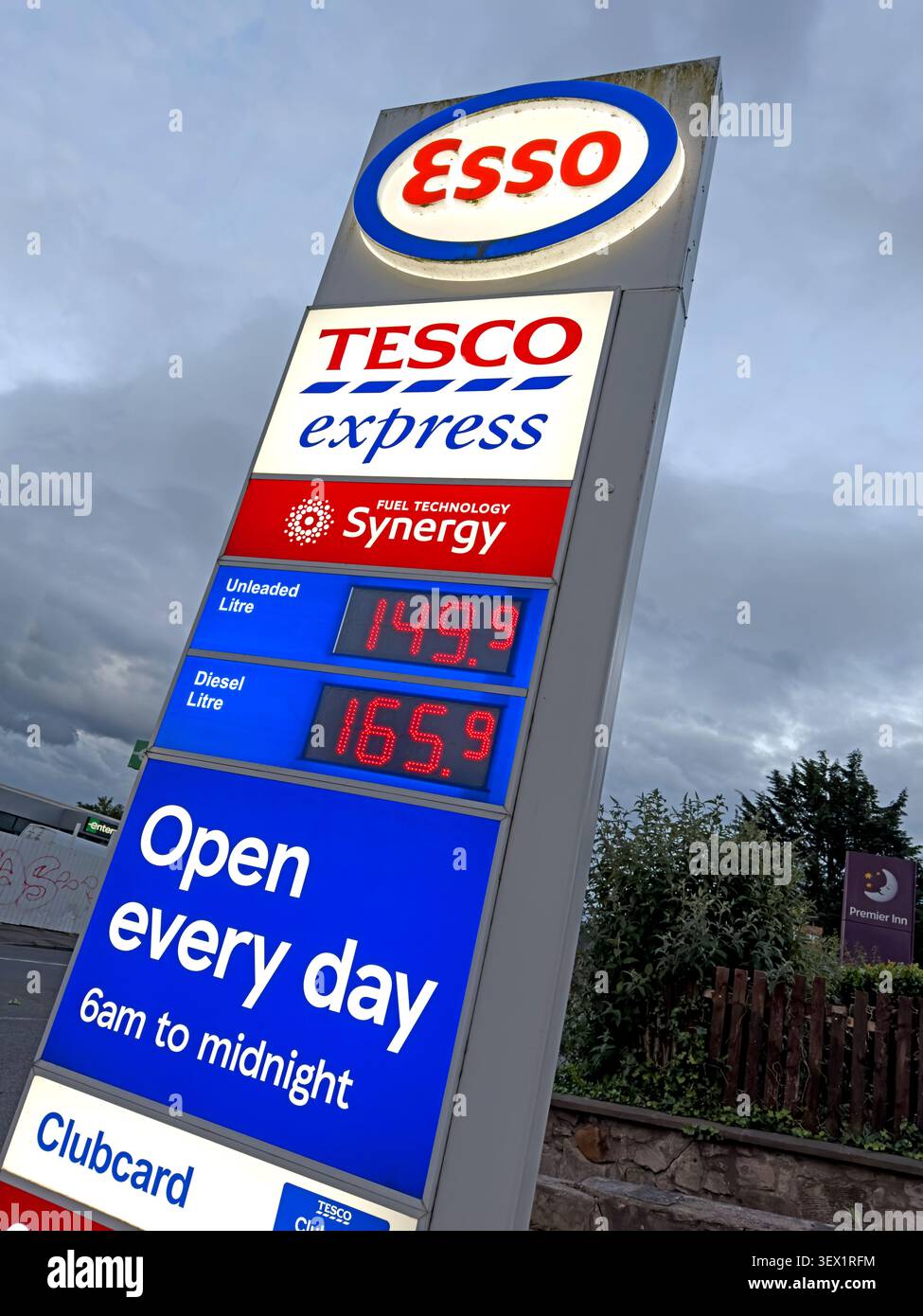
An illuminated Esso and Tesco Express roadside price sign stands against a darkening, cloud-filled sky on Willowbrae Road in the Duddingston area of Edinburgh, Scotland. The digital display shows unleaded petrol priced at 165.9 pence per litre. Esso Synergy branding, Tesco Express signage and the opening hours, “Open every day 6am to midnight”, are clearly visible. The photograph records the everyday impact of expensive motor fuel on drivers, households and businesses. A price above £1.65 a litre makes the image suitable for editorial coverage of motoring costs, inflation, household budgets, commuting expenses, haulage charges and cost-of-living pressures. It also illustrates the relationship between global crude-oil markets, refinery supply, taxation, retail competition and neighbourhood pump prices. The scene has particular relevance to the 2026 Iran conflict and renewed disruption around the Strait of Hormuz, one of the world’s most important oil-shipping routes. Military escalation, attacks on commercial vessels and restrictions affecting passage through the Gulf have intensified concern over energy security and the vulnerability of international petroleum supplies. Even when benchmark crude prices ease, disruption to tanker movements, refining capacity and fuel inventories can continue to affect wholesale petrol and diesel markets. Located east of Edinburgh city centre on the A1 corridor, the station combines an Esso forecourt with a Tesco Express convenience store. It serves local residents, commuters and traffic travelling between central Edinburgh, Duddingston, Portobello and East Lothian. The low-angle composition makes the illuminated logos and red digital fuel price dominant against the blue-grey evening sky. Heavy clouds and fading daylight add a sombre atmosphere appropriate to debate about war-driven energy shocks, dependence on imported oil, transport affordability and British consumers’ exposure to distant geopolitical events