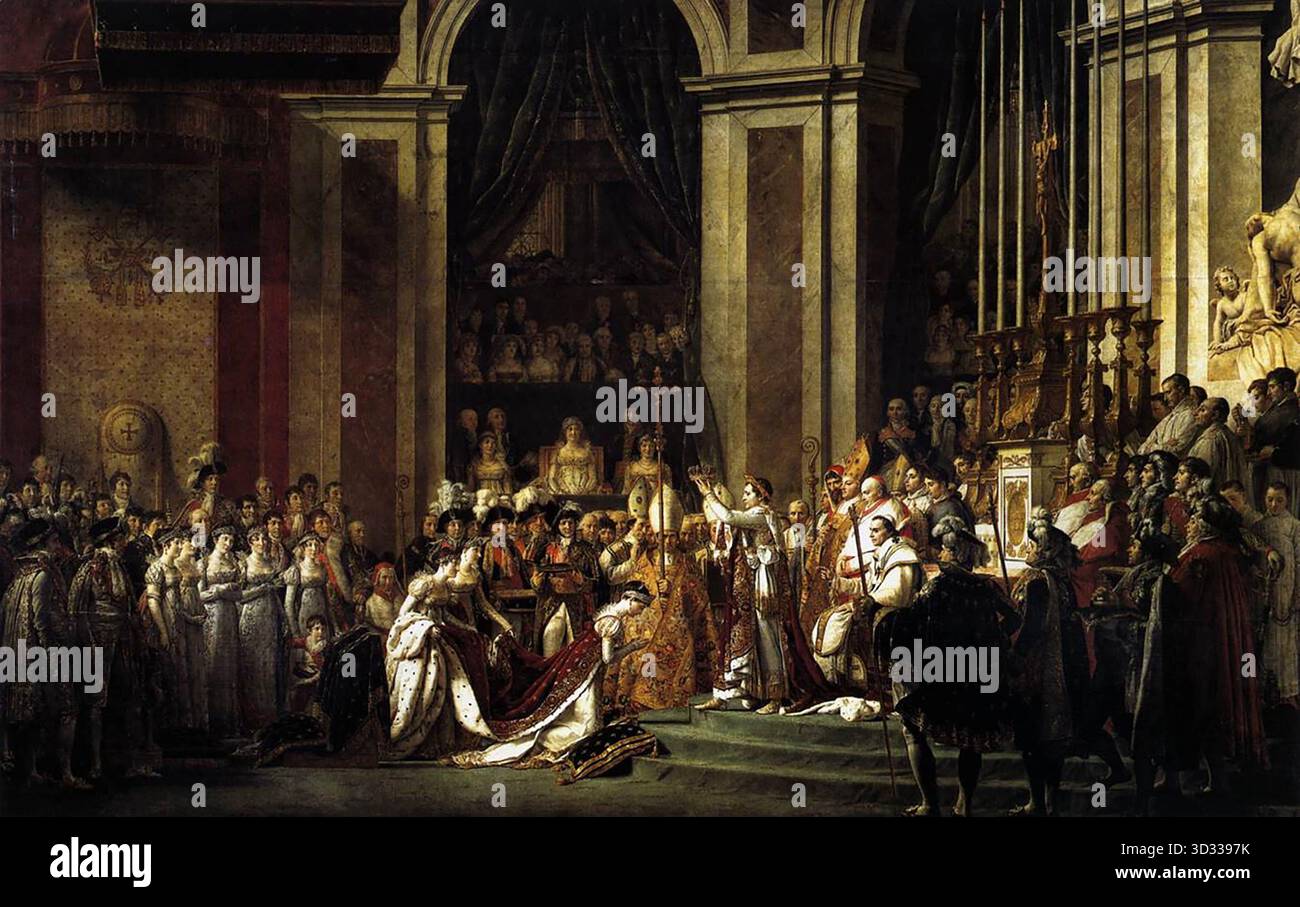
DAVID, Jacques-Louis (* 1748, Paris, d. 1825, Bruxelles) Weihe des Kaisers Napoleon I. und Krönung der Kaiserin Josephine 1805-07 Öl auf Leinwand, 629 x 979 cm Mus?e du Louvre, Paris der genaue Titel des Gemäldes lautet: Weihe des Kaisers Napoleon I. und Krönung der Kaiserin Josephine in der Kathedrale Notre-Dame de Paris am 2. Dezember 1804. David wurde von Napoleon beauftragt, eine große Komposition zu malen, die an seine Weihe erinnert, die am 2. Dezember 1804 in Notre Dame in Paris stattgefunden hatte. Das Bild wurde im Salon Carr ausgestellt? Im Louvre 1808, t
3500 x 2200 px | 29,6 x 18,6 cm | 11,7 x 7,3 inches | 300dpi
Aufnahmedatum:
4. November 2025
Weitere Informationen:
Dieses Bild kann kleinere Mängel aufweisen, da es sich um ein historisches Bild oder ein Reportagebild handel
DAVID, Jacques-Louis (b. 1748, Paris, d. 1825, Bruxelles) Consecration of the Emperor Napoleon I and Coronation of the Empress Josephine 1805-07 Oil on canvas, 629 x 979 cm Mus?e du Louvre, Paris The exact title of the painting is: Consecration of the Emperor Napoleon I and Coronation of the Empress Josephine in the Cathedral of Notre-Dame de Paris on 2 Dec 1804. David was commissioned by Napoleon to paint a large composition commemorating his consecration, which had taken place in Notre Dame in Paris, on 2 December 1804. The picture was exhibited in the Salon Carr? in the Louvre in 1808, then in the Salon of that year; it was next placed in the Tuileries, in the Salle des Gardes. Under Louis Philippe it was installed at Versailles in a room decorated in imitation of the Empire style, together with David's Distribution of the Eagles and Gros' Battle of Aboukir; in 1889 it was transferred to the Louvre, and its place at Versailles was taken by Roll's Marseillaise. In 1947 this latter picture was replaced by a replica of David's Consecration of Napoleon, begun by the painter in 1808 and not finished till 1822, in Brussels; this replica was bought by the Mus?es de France in England, in 1946. David seems to have derived his general composition from Rubens' Coronation of Queen Marie de Medici. In accordance with David's usual method, numerous studies, both painted and drawn, preceded the actual execution of the work. The best-known of these is the portrait of Pius VII, now in the Louvre. The painter then made a model, where he arranged dolls in costume. David had originally intended to portray the event faithfully, showing Napoleon crowning himself. The Emperor, remembering the quarrels between the Pope and the Holy Roman Empire, placed the crown on his own head to avoid giving a pledge of obedience of the temporal power to the Pontiff. But he evidently felt that it would not be desirable to perpetuate this somewhat disrespectful action in paint; so David painted t