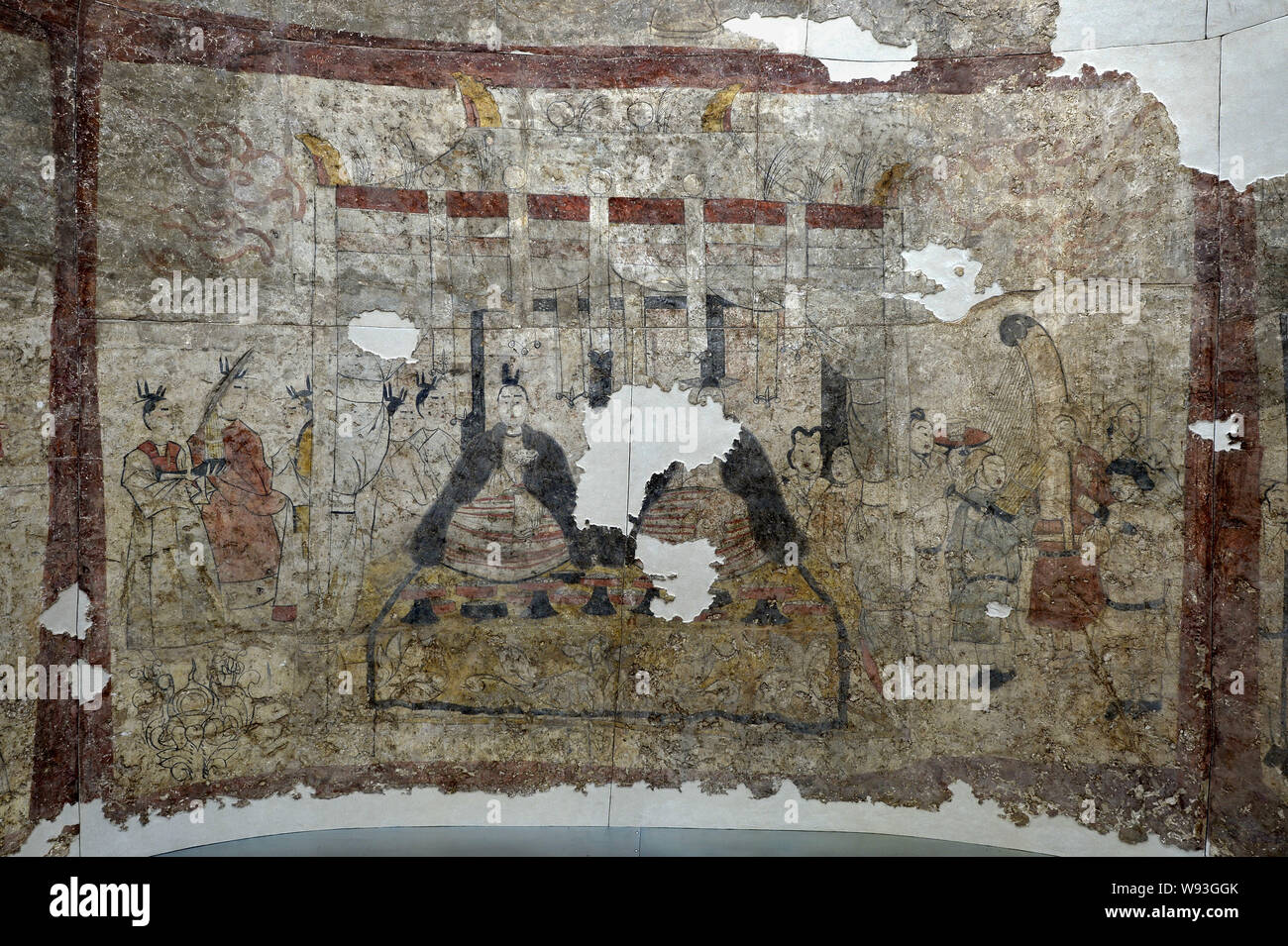
Details zu ein Fresko in der Kammer von einem wandbild Grab des nördlichen Qi Dynastie (550-577 AD), der in Shuozhou Stadt ausgegraben wurde gesehen, in der Basis
Details of a fresco are seen in the chamber of a mural tomb of the Northern Qi Dynasty (AD 550-577), which was excavated in Shuozhou City, in the basement of the Shanxi Museum in Taiyuan city, north Chinas Shanxi province, 9 July 2013. A colorful, well-preserved mural tomb, where a military commander and his wife were likely buried nearly 1, 500 years ago, has been uncovered in China. The domed tombs murals, whose original colors are largely preserved, was discovered in Shuozhou City, about 200 miles (330 kilometers) southwest of Beijing. Researchers estimate that the murals cover an area of about 860 square feet (80 square meters), almost the same area as a modern-day bowling lane. Archaeologists believe the couple buried at the site consisted of a military commander, in charge of the Shuozhou City area, and his wife. This makes sense given the date of the tomb. Historians know that at the time this couple lived, three rival dynasties battled for control of China. The buried commander served the Northern Qi, a short-lived dynasty that lasted between A.D. 550 and 577, when it was conquered by another group of rulers known as the Northern Zhou.