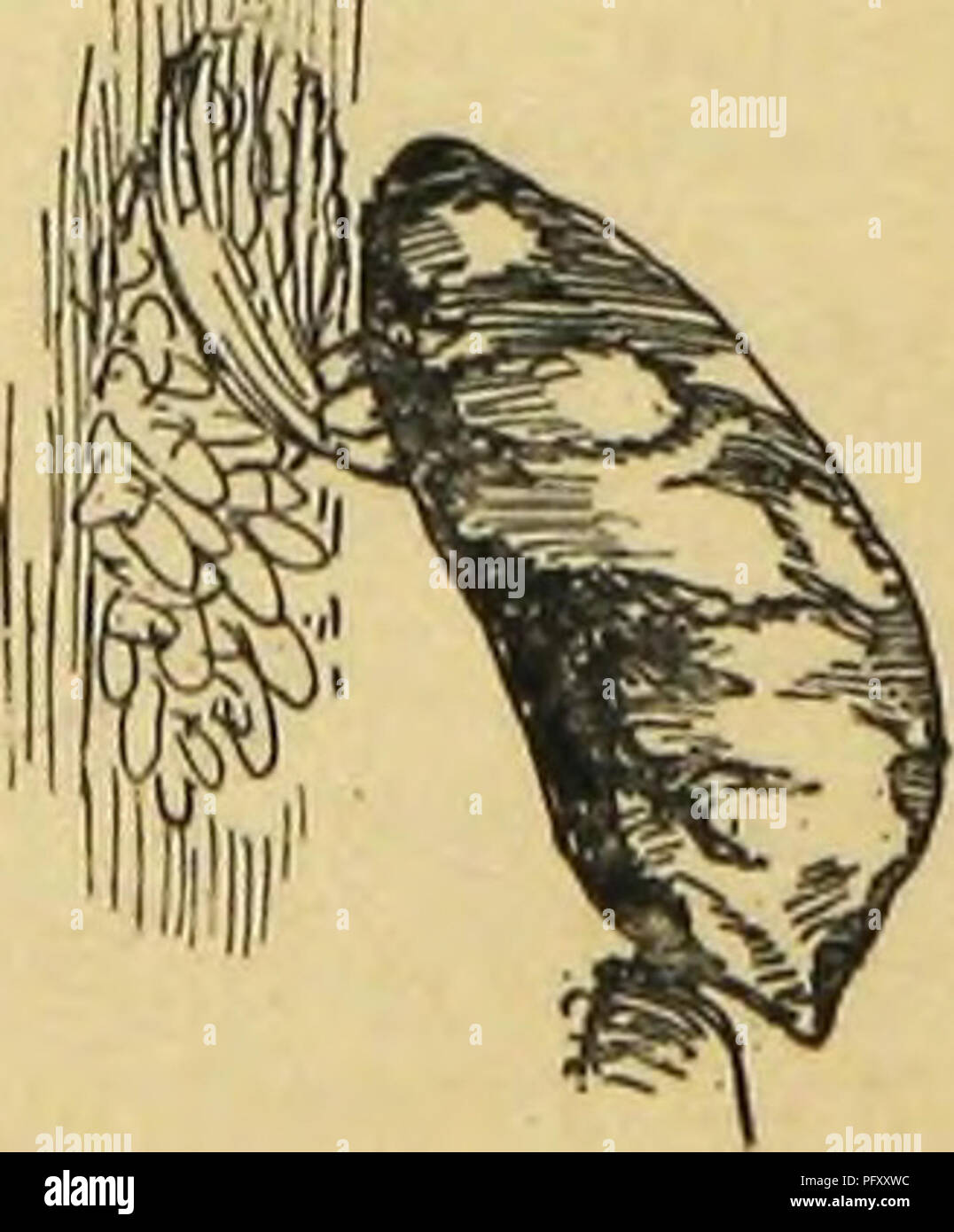
Diese naturgeschichtliche Arbeit über amerikanische Spinnen erklärt ihr Verhalten beim Spinnen im Netz. Es beschreibt, wie die Spinne Seidenschlaufen erzeugt, indem sie ihren Bauch benutzt, um die Fäden zu manipulieren und ein strukturiertes Netz zum Fangen von Beute zu bilden. Der Spinning-Prozess ist ein wesentlicher Bestandteil ihrer Überlebensstrategie.
1439 x 1737 px | 24,4 x 29,4 cm | 9,6 x 11,6 inches | 150dpi
Weitere Informationen:
Nur Zugriffsrechte. Dies ist ein Handout- oder gemeinfreies Bild, das von einem Dritten bereitgestellt wurde. Alamy gewährt Zugriff auf die digitale Datei, übernimmt jedoch keine Gewährleistungen hinsichtlich Urheberrecht oder Persönlichkeitsrechten. Änderungen, Bearbeitungen oder Zuschnitte sind ohne vorherige Genehmigung untersagt. Alle kommerziellen Nutzungen erfordern eine vorherige Genehmigung des Inhaltsanbieters.
Dieses Bild kann kleinere Mängel aufweisen, da es sich um ein historisches Bild oder ein Reportagebild handel
. American spiders and their spinning work. A natural history of the orbweaving spiders of the United States, with special regard to their industry and habits. Spiders. a motion wliich causes the threads to rapidly contract and gather into a little ball of loops near the surface of the web. (Fig. 92.) The spider then swings her abdomen well to one side of this flossy hump of loops, as at Fig. 93, drawing after her a ray of milky filaments. Next, she draws back her abdomen, which is held close to the shield space, pulls tlie taut lines over the flossy mass (Fig. 94), and the spinnerets are then moved back and forth with a lateral motion like the spreading of mortar by a mason's trowel, thus pushing, beating, or spreading the loops against the cross lines of the hub. The spider repeats these motions, at the same time shifting her position occasionally, thus revolving her- self by her feet around the circle of the shield. As the spimierets, of course, revolve with the body, the weaving process is continually repeated, and the shield gradually Pin. 93. A third position, formed. The movemcnt of the spinnerets is from the to'^one side, " drawing ccutrc of tlic hub outward, aud it follows that as the out a second ray of greatest quantity and thickness of silk issue at the first expulsion and gradually diminish, the centre receives the heaviest coating, and this decreases toward the margin. The fact that the shield is more closely woven in the centre is thus accounted for. This describes the ordinary method by which Argiope's shield is spun, but there are other modes. One continually finds, in studying tlie new made webs of this species, that the zigzag ribbon entirely traverses the hub, in which there is no trace of the shield except a few straggling lines. In this case the ribbon has evidently been spun first. Again, one sees the same extended ribbon, and, in addition, on either side are woven one or more zigzag bands, arranged in arcs of circles, which occupy the j||