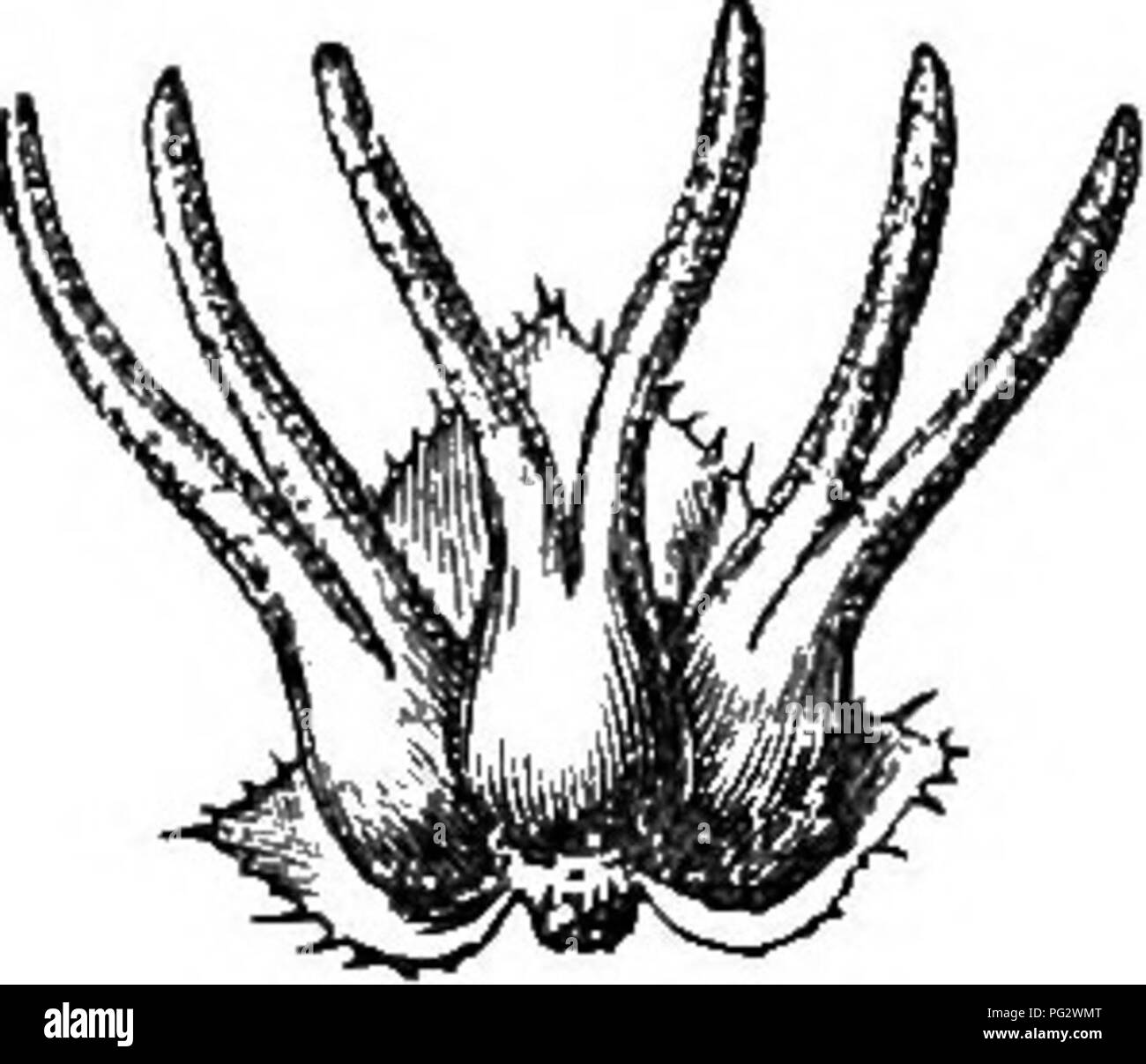
Dieser Eintrag in der Studie der natürlichen Pflanzengeschichte erforscht die Eigenschaften von *Betula alba*, wobei er sich auf seine Blätter, Blüten und Fortpflanzungsmerkmale konzentriert. Die Beschreibungen vermitteln ein wesentliches Wissen über seine Wachstumsmuster und ökologischen Rollen.
1705 x 1465 px | 28,9 x 24,8 cm | 11,4 x 9,8 inches | 150dpi
Weitere Informationen:
Dieses Bild ist ein gemeinfreies Bild. Dies bedeutet, dass entweder das Urheberrecht dafür abgelaufen ist oder der Inhaber des Bildes auf sein Urheberrecht verzichtet hat. Alamy berechnet Ihnen eine Gebühr für den Zugriff auf die hochauflösende Kopie des Bildes.
Dieses Bild kann kleinere Mängel aufweisen, da es sich um ein historisches Bild oder ein Reportagebild handel
. The natural history of plants. Botany. 223 NATURAL HISTORY OF PLANTS. have alternate simple leaves, dentate or entire, not persistent, witli petioles accompanied at the base by two lateral caducous stipules. Young, they are plicate and equitant in the interior of a scaly bud. The flowers are generally monce- Betula alba. ^fes, Fig. 154. Male floriferous snale witlioiiit flowers. Fig. 153. Male flowers. cious and collected in unisexual catkins, which are solitary, or more rarely in clusters, ^ to the number of two or four as in the Asiatic species constituting the genus Betulaster^ In the axil of each scale of the male catkin, there is a cyme, formed generally of three flowers, a median and two lateral, rising from the axil- lant scale and accompanied by two secondary scales, similarly supported and interior, one on each side.^ In the female cat- kins, there is in the axil of each scale, accompanied also by four secondary scales, a biparous cyme three- or more-flowered, often re- duced to two fl.owers.* In the fructiferous catkin, the principal accrescent scales accompanied by the secondary scales embodied with them, ^ are detached early or persist for a longer or shorter period on the axis of the catkin, with the samarse, which they completely conceal in all the Birches. Fig. 156. Triflorous fe- male cyme. Fig. 151. Young foli aceous 'branoli. Fig. 157. Long, female flower sect, of 1 Often, as in B. fruticosa, the axis of a fe- male catkin thickens and its lower portion persists and ultimately developes into a branch, which, the following year, bears leaves and flowers, the female catkins of which will lite- wise have a persistent base. = Spaoh, Ann. So. Nat. s&. 2, xv. 182, 198.â Endl. Gen. Suppl. iv. p. ii. 20. ' They have often been considered as sti- pules of the principal bract or scale. Previous to their late displacement they appear, from the situation, to represent two lateral bracteoles, the axil of which would be occupied by the lateral flowers of the