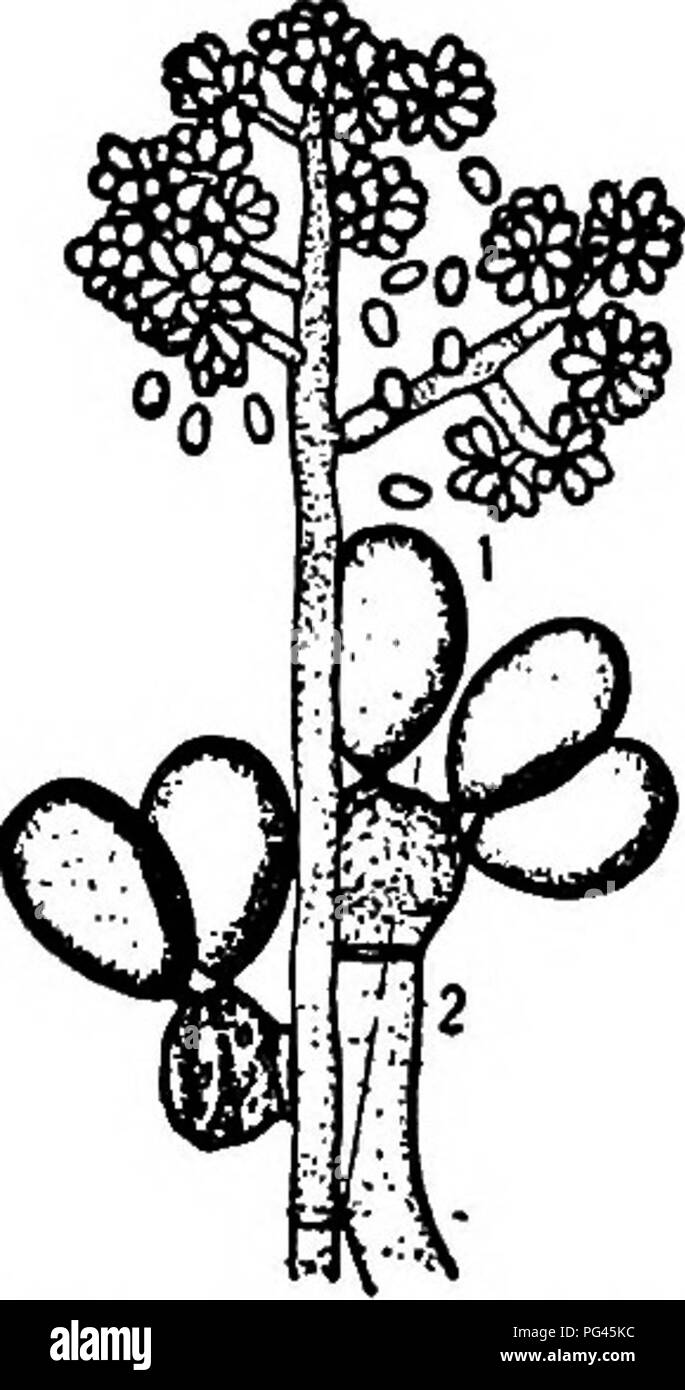
Dieser Text enthält eine detaillierte Untersuchung von Pilzen, die für Pflanzenkrankheiten verantwortlich sind, wobei der Schwerpunkt auf Arten wie Botrytis cinerea liegt. Sie enthält Beschreibungen ihrer Struktur, ihres Wachstums und ihrer Auswirkungen auf Kulturen wie Trauben, die zum Verständnis der Pflanzenpathologie und der Behandlung von Pilzinfektionen in der Landwirtschaft beitragen.
1148 x 2177 px | 19,4 x 36,9 cm | 7,7 x 14,5 inches | 150dpi
Weitere Informationen:
Nur Zugriffsrechte. Dies ist ein Handout- oder gemeinfreies Bild, das von einem Dritten bereitgestellt wurde. Alamy gewährt Zugriff auf die digitale Datei, übernimmt jedoch keine Gewährleistungen hinsichtlich Urheberrecht oder Persönlichkeitsrechten. Änderungen, Bearbeitungen oder Zuschnitte sind ohne vorherige Genehmigung untersagt. Alle kommerziellen Nutzungen erfordern eine vorherige Genehmigung des Inhaltsanbieters.
Dieses Bild kann kleinere Mängel aufweisen, da es sich um ein historisches Bild oder ein Reportagebild handel
. The fungi which cause plant disease . Plant diseases; Fungi. THE FUNGI WHICH CAUSE PLANT DISEASE 579 The more prominent forms as described are given below, recog- nizing that some of them may be co-specific. B. cinerea Pers.''"-''' Hyphae slender, constricted at septa, gregarious, simple or sparsely branched, erect, cinereous, conidia globose, pale. A form which occurs on the grape is usually referred to S. fuckeliana though there is not entire agreement on this point. On the grape the Botrytis develops its mycelium in the berries and produces dense tufts of conidia over their surfaces. The sclerotia form: within the fruits. Leaves and canes are also affected, (see p. 140). On the lily Ward^'^ in a classic study de- monstrated the parasitism of the fungus show- ing its action to be dependent upon toxins and enzymes. The t3T)e in this case deviated some- what from the usual B. cinerea in that its spores were a little larger than is usual, but it nevertheless seemed to be this species. No ascigerous stage was found. On Cyclamen and Primula Wehmer^'* re- ports a similar case.-*" The fungus has also often been reported on the cultivated gera- ^°- 388.—b. cinerea. ^ ^ After Smith. mum. On lettuce Humphrey, "^ Jones, ^'* Bailey, ''^* and many others have reported a greyish mold on the leaves due to a Botrytis which is often cited as B. cinerea though it appears to form no ascigerous stage. The affected part of the leaf collapses and is covered with a conspicuous growth of the conidiophores and coni- dia. Small sclerotia are produced in considerable abundance when on artificial media but they, on germination, bear clusters, dense bushy tufts, of conidiophores. That this form on lettuce ever produces ascophores is doubtful. Smith describes a case in which linden stems beginning at the ground were parasitized by B. cinerea. The bark appeared to be first affected and sclerotia formed in the cortical parenchjmia. Similar cases are on record regarding the ros