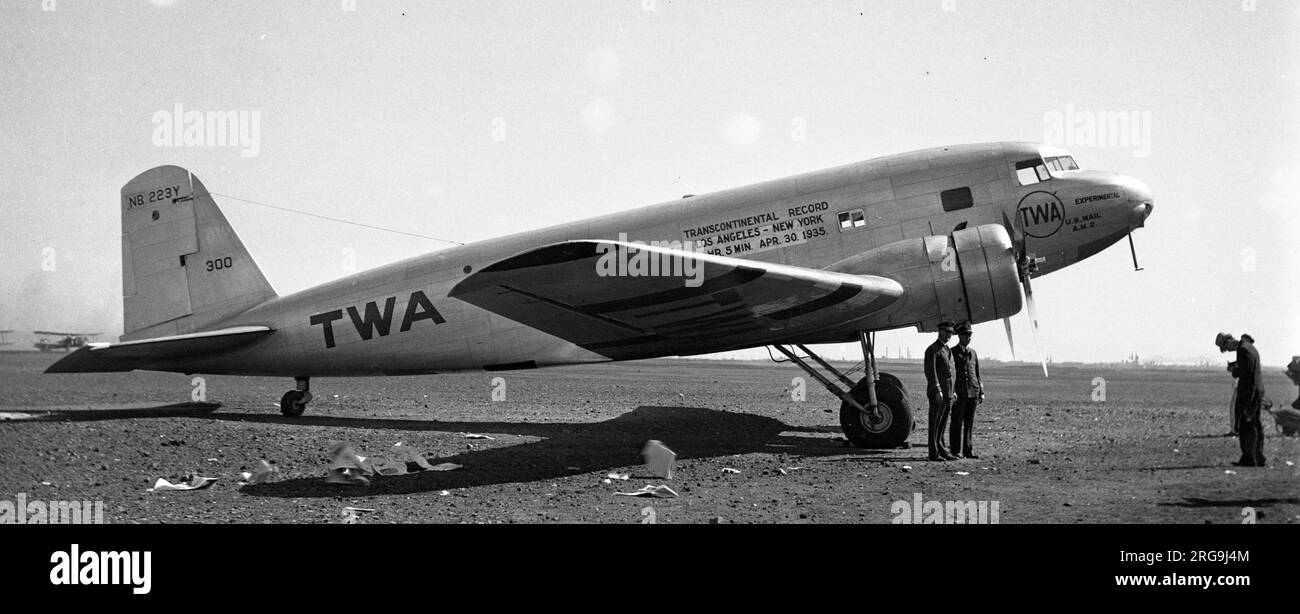
Douglas DC-1 NR223Y von Transcontinental & Western Air (TWA) wurde von TWA als Fluglabor geflogen und für gelegentliche Passagierflüge wurde NR233Y von Jack Frye und Eddie Rickenbacker von Los Angeles nach Newark in 13 Stunden und 4 Minuten zu einem Rekordflug am 19. Februar 1934 geflogen. Information: Nach dem Rekordflug 1934 wurde NR233Y mit Langstreckentanks in der Kabine umgebaut, um die Kraftstoffkapazität t zu erhöhen
Dieses Bild kann kleinere Mängel aufweisen, da es sich um ein historisches Bild oder ein Reportagebild handel
Douglas DC-1 NR223Y of Transcontinental & Western Air (TWA) Flown by TWA as a flying laboratory and for occasional scheduled passenger flights, NR233Y was flown by Jack Frye and Eddie Rickenbacker from Los Angeles to Newark in 13 hours 4 minutes, for a record transcontinental flight on 19 February 1934. Information: After the record breaking flight in 1934, NR233Y was modified with long-range tanks in the cabin increasing fuel capacity to 2100 US gallons, removal of cabin windows, re-engined with 785 hp Wright SGR-1820-F25 engines and increased maximum take-off weight (MTOW) to 28500 lb. To ensure that the aircraft could land at the maximum landing weight (MLW) in an emergency, dump valves allowed all fuel to be dumped overboard in three minutes. Once modified the aircraft was leant to the National Aeronautical Association for attempts at various distance and weight-carrying records for the US and the World. On its delivery flight to the East Coast for the intended flights NR233Y broke its own speed record set the year before. On 30 April 1935, NR233Y crewed by D.W. Tomlinson, HH.B. Snead and J.S. Bartles flew from Burbank to New York in 11 hours 5 minutes. Between 16 and 19 May 1935 NR233Y set or broke 22 records, including 8 world records. After these record-breaking flights the aircraft was sold by TWA to Western Aero & Radio Co. of Burbank, for Howard Hughes, who planned to make further national and international record attempts.
Ausschließlich für die redaktionelle Nutzung freigegeben.
Verwendung im Zusammenhang mit Nachrichten berichterstattung, Rezensionen und Kritik sowie der Übermittlung von Informationen über Personen, Orte, Dinge, Ereignisse oder Geschehnisse.
Zur Klarstellung: Die redaktionelle Nutzung umfasst keine Nutzung im Zusammenhang mit Werbung, Verkaufsförderung (z. B. verkaufsfördernde Webseiten), Marketing, Verpackung oder Merchandising.