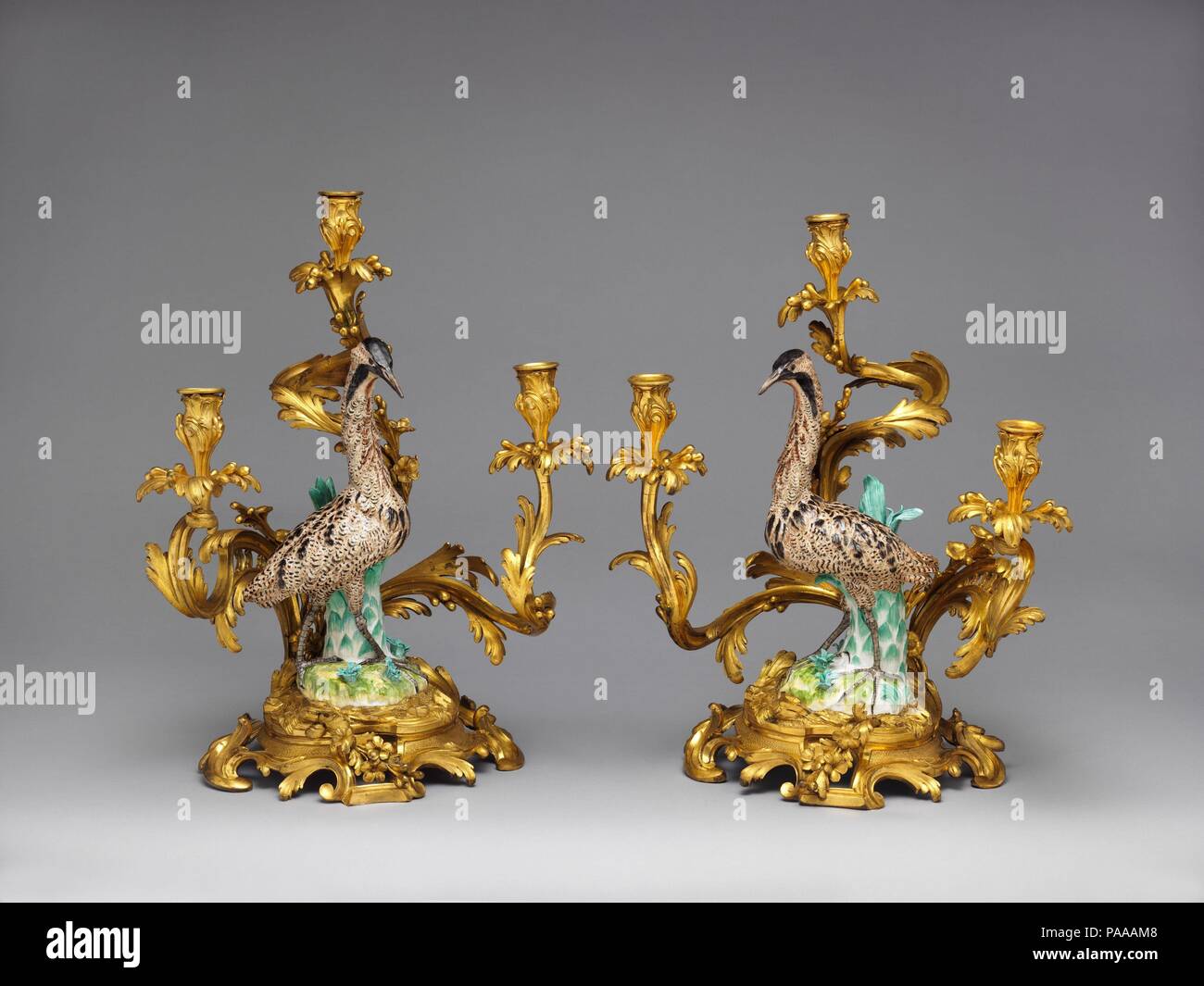
Drei-light Kandelaber (candélabre oder GIRANDOLE) (einer der beiden). Kultur: Deutsche, Meissen mit Französischen, Paris. Abmessungen: Höhe (insgesamt): 23 in. (58,4 cm); Höhe (Vogel): 15. (38,1 cm). Manufaktur: Meissen Manufaktur (Deutsch, 1710). Modeler: Modell für die Rohrdommel zugeschrieben Johann Joachim Kändler (Deutsch, Fischbach 1706-1775 Meißen). Datum: Ca. 1750. Ausgebildet als Bildhauer, Johann Joachim Kändler trat der Porzellanmanufaktur in Meißen, in der Nähe von Dresden, als Modelleur in 1731. Ein reicher und talentierter Künstler, Kändler lieferte die Workshops mit zahlreichen Modellen, rangin
Dieses Bild kann kleinere Mängel aufweisen, da es sich um ein historisches Bild oder ein Reportagebild handel
Three-light candelabra (candélabre or girandole) (one of a pair). Culture: German, Meissen with French, Paris mounts. Dimensions: Height (overall): 23 in. (58.4 cm); Height (bird): 15 in. (38.1 cm). Manufactory: Meissen Manufactory (German, 1710-present). Modeler: Model for bittern attributed to Johann Joachim Kändler (German, Fischbach 1706-1775 Meissen). Date: ca. 1750. Trained as a sculptor, Johann Joachim Kändler joined the porcelain manufactory in Meissen, near Dresden, as a modeler in 1731. A prolific and talented artist, Kändler supplied the workshops there with numerous models, ranging from small figural groups to table services and decorative wares. Among his most celebrated achievements were the animal figures he created for the Japanese Palace in Dresden at the behest of Augustus the Strong, elector of Saxony (1670-1733), which included many native European and exotic birds. These figures were based either on live specimens observed at the royal menagerie at Moritzburg or on stuffed ones preserved in the local natural-history collection, and they illustrate the contemporary fascination with the natural world. In March 1735, for the Japanese Palace, Kändler modeled his first bittern, an elusive long-necked bird that moves through the reeds along the shore stalking fish. Different, smaller models of bittern by the artist seem to have been popular during the mid-eighteenth century, and multiple pairs are known today. With their attractive gray and brown plumage and dark streaks, the graceful heronlike birds strut on mounds embellished with a thicket of water plants and rushes. In Paris various Meissen porcelain birds were combined with fanciful gilt-bronze mounts to make exquisite candelabra such as these, for which the marchands-merciers asked steep prices. Lazare Duvaux's account book lists several pairs of three-light girandoles that were sold between 1748 and 1751. Two of them incorporated Meissen swans, and the third, unidentified Meissen porcelain bi