3810 x 2396 px | 32,3 x 20,3 cm | 12,7 x 8 inches | 300dpi
Aufnahmedatum:
26. Juli 2018
Weitere Informationen:
Dieses Bild ist ein gemeinfreies Bild. Dies bedeutet, dass entweder das Urheberrecht dafür abgelaufen ist oder der Inhaber des Bildes auf sein Urheberrecht verzichtet hat. Alamy berechnet Ihnen eine Gebühr für den Zugriff auf die hochauflösende Kopie des Bildes.
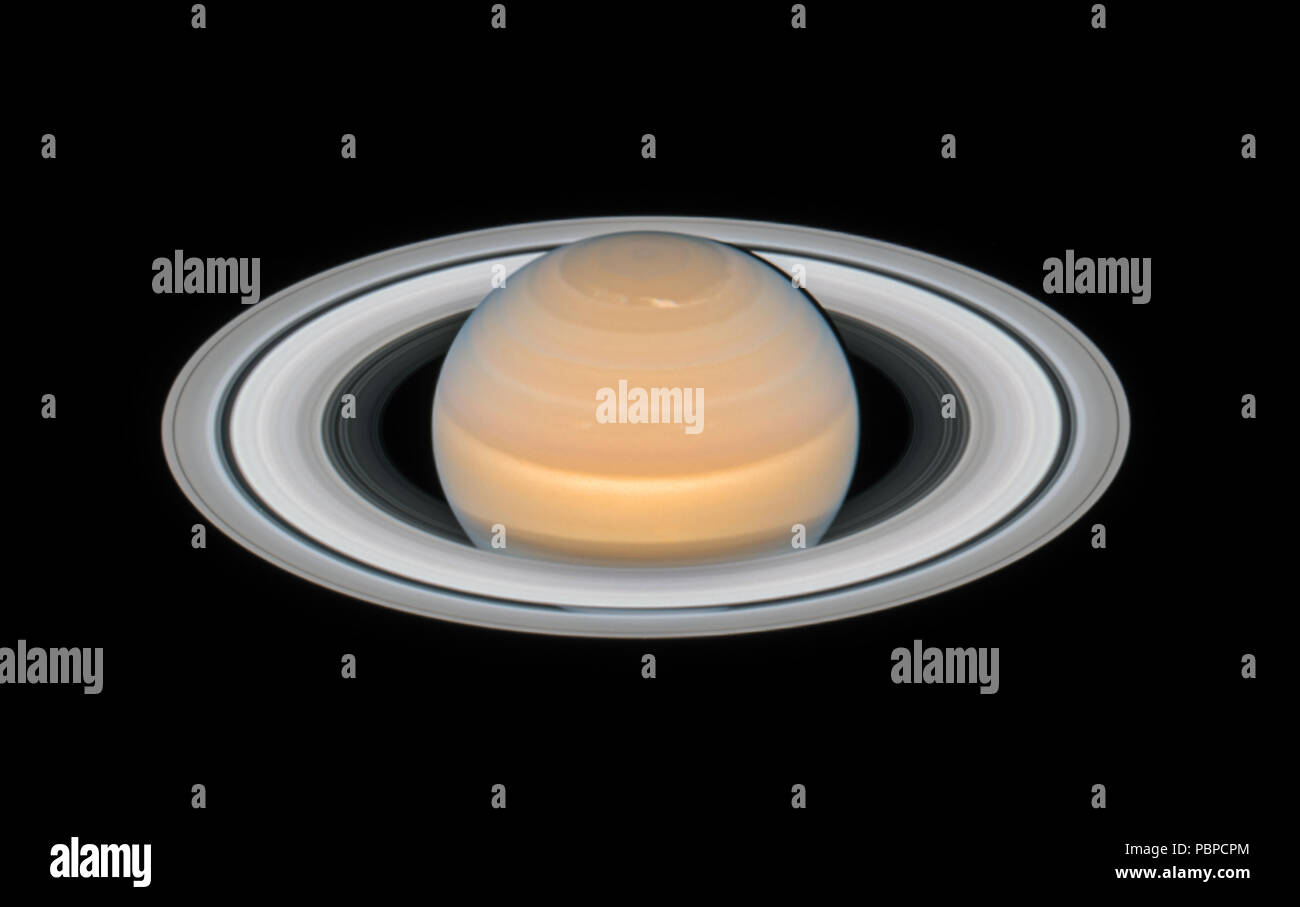
Saturn is by far the solar system’s most photogenic planet, and in this latest Hubble Space Telescope snapshot it is especially so because Saturn’s magnificent ring system is near its maximum tilt toward Earth (which was in 2017). Hubble was used to observe the planet on June 6, 2018, when Saturn was only approximately 1.36 billion miles from Earth, nearly as close to us as it ever gets. Saturn was photographed as it approached a June 27 opposition, when the planet is directly opposite to the Sun in the night sky and is at its yearly closest distance to the Earth. Though all of the gas giants boast rings, Saturn’s are the largest and most spectacular, stretching out eight times the radius of the planet. Saturn’s stunning rings were first identified as a continuous disk around the planet by Dutch astronomer Christiaan Huygens in 1655. 325 years later, NASA’s Voyager 1 spacecraft flyby of Saturn resolved thousands of thin, fine ringlets. Data from NASA’s Cassini mission suggests the rings formed 200 million years ago, roughly around the time of the dinosaurs and Earth’s Jurassic period. The gravitational disintegration of one of Saturn’s small moons created myriad icy debris particles, and collisions today likely continually replenish the rings. Visible in this Hubble image are the classic rings as recorded by early skywatchers. From the outside in are the A ring with the Encke Gap, the Cassini Division, the B ring, and the C ring with the Maxwell Gap. Saturn’s appearance changes due to its seasons, caused by the planet’s 27-degree axial tilt. It is now summer in Saturn’s northern hemisphere and the atmosphere is more active. This may be responsible for a string of bright clouds visible near the northern polar region that are the remnants of a disintegrating storm. Small, mid-latitude puffs of clouds are also visible. Hubble’s view also resolves a hexagonal pattern around the north pole, a stable and persistent wind feature discovered duri
Ausschließlich für die redaktionelle Nutzung freigegeben.
Verwendung im Zusammenhang mit Nachrichten berichterstattung, Rezensionen und Kritik sowie der Übermittlung von Informationen über Personen, Orte, Dinge, Ereignisse oder Geschehnisse.
Zur Klarstellung: Die redaktionelle Nutzung umfasst keine Nutzung im Zusammenhang mit Werbung, Verkaufsförderung (z. B. verkaufsfördernde Webseiten), Marketing, Verpackung oder Merchandising.