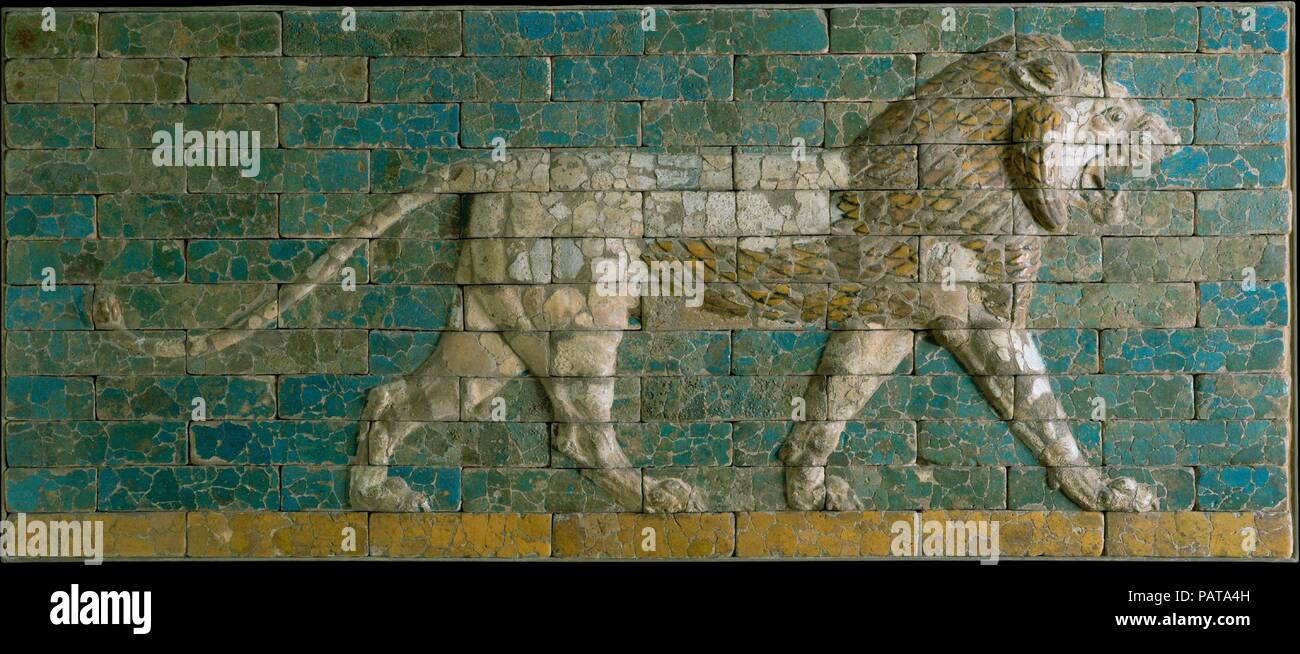
Panel mit schreitenden Löwen. Kultur: BABYLONISCHE. Abmessungen: H.38 cm. (97,2 cm). Datum: Ca. 604-562 v. Chr.. Das assyrische Reich fiel vor der kombinierten Angriffe der Babylonier und Meder in 614 und 612 v. Chr. In den letzten Tagen des Imperiums, Nabopolassar (r. 625-605 v. Chr.), die in der Assyrischen service gewesen war, wurde eine neue Dynastie mit der Hauptstadt Babylon. Während der Herrschaft von seinem Sohn Nebukadnezar II. 604-562 v. Chr.), der Neubabylonischen reiches ihren Höhepunkt erreicht. Dies war vor allem auf Nebukadnezars Fähigkeit als Staatsmann und General. Er freundschaftliche Beziehungen zu den Med
Dieses Bild kann kleinere Mängel aufweisen, da es sich um ein historisches Bild oder ein Reportagebild handel
Panel with striding lion. Culture: Babylonian. Dimensions: H. 38 1/4 in. (97.2 cm). Date: ca. 604-562 B.C.. The Assyrian Empire fell before the combined onslaughts of Babylonians and Medes in 614 and 612 B.C. In the empire's final days, Nabopolassar (r. 625-605 B.C.), who had been in Assyrian service, established a new dynasty with its capital in Babylon. During the reign of his son, Nebuchadnezzar II (r. 604-562 B.C.), the Neo-Babylonian empire reached its peak. This was largely attributable to Nebuchadnezzar's ability as a statesman and general. He maintained friendly relations with the Medes in the east while vying successfully with Egypt for the control of trade on the eastern Mediterranean coast. He is well known as the biblical conqueror who deported the Jews to Babylon after the capture of Jerusalem. During this period Babylon became the city of splendor described by Herodotus and the Old Testament Book of Daniel. Because stone is rare in southern Mesopotamia, molded glazed bricks were used for building and Babylon became a city of brilliant color. Relief figures in white, black, blue, red, and yellow decorated the city's gates and buildings. The most important street in Babylon was the Processional Way, leading from the inner city through the Ishtar Gate to the Bit Akitu, or "House of the New Year's Festival." The Ishtar Gate, built by Nebuchadnezzar II, was a glazed-brick structure decorated with figures of bulls and dragons, symbols of the weather god Adad and of Marduk. North of the gate the roadway was lined with glazed figures of striding lions. This relief of a lion, the animal associated with Ishtar, goddess of love and war, served to protect the street; its repeated design served as a guide for the ritual processions from the city to the temple. Museum: Metropolitan Museum of Art, New York, USA.