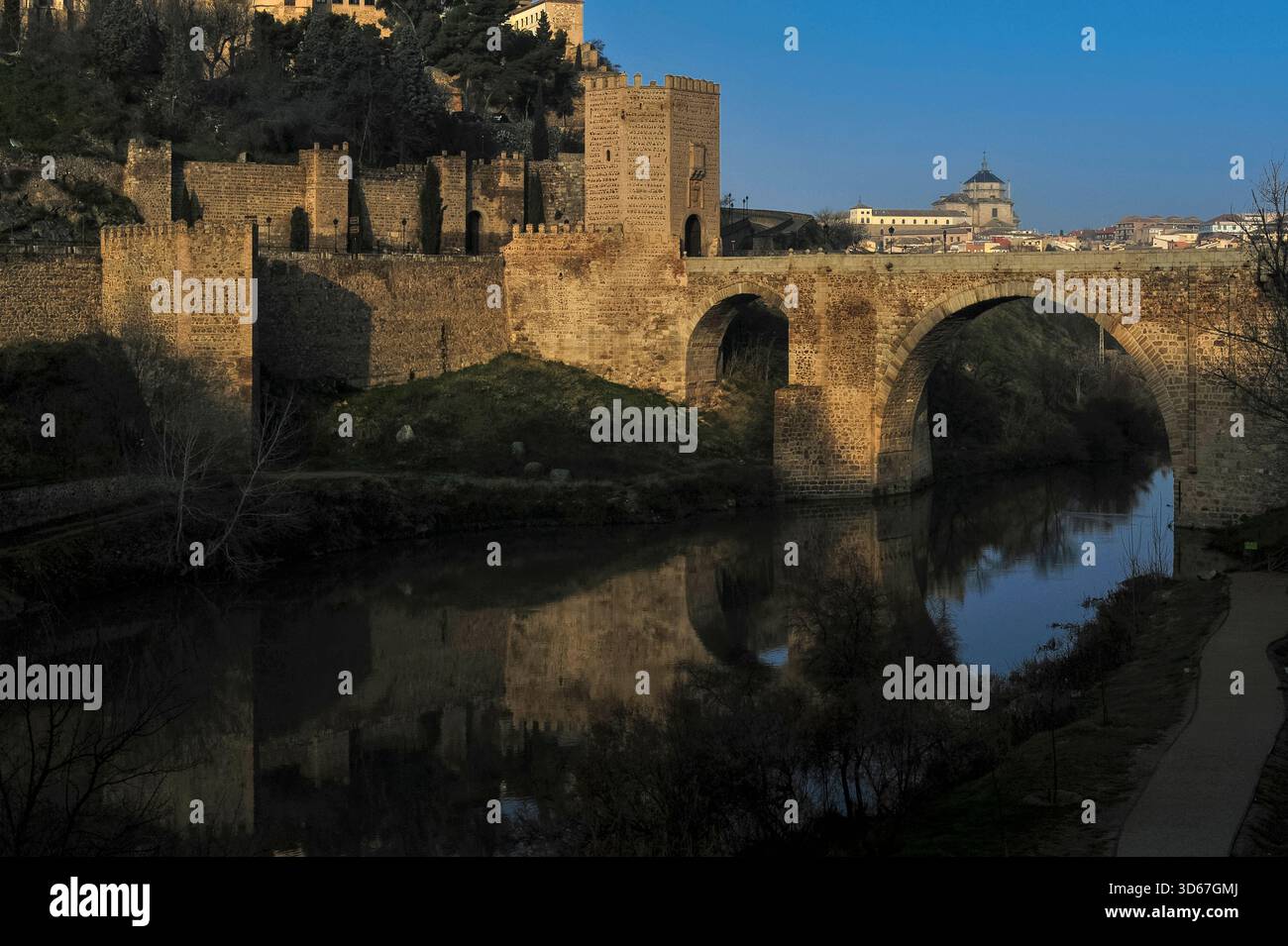
Römische und mittelalterliche Puente de Alcántara oder Alcántara-Brücke, die sich im ruhigen Fluss Tejo unter der UNESCO-Weltkulturerbestätte Toledo, Kastilien-La Mancha, Zentralspanien, spiegelt. Erbaut für das römische Municipium von Toletum, von den Westgoten genutzt und von den Mauren wiederaufgebaut, mit dem Westtor-Turm mit königlichen Wappen der spanischen katholischen Monarchen aus dem 15. Jahrhundert, Ferdinand und Isabella.
4256 x 2832 px | 36 x 24 cm | 14,2 x 9,4 inches | 300dpi
Aufnahmedatum:
29. Dezember 2010
Ort:
Toledo, Castilla-La Mancha, Spain
Weitere Informationen:
Dieses Bild kann kleinere Mängel aufweisen, da es sich um ein historisches Bild oder ein Reportagebild handel
Toledo, Castilla-La Mancha, Spain: on a peaceful December morning, the Roman and medieval Puente de Alcántara or Alcántara Bridge reflects in the calm surface of the River Tagus flowing below the UNESCO World Heritage Old Town and its historic monuments. The bridge was probably built in the 2nd century AD, long after the Romans had captured the settlement of the Carpetani, Celtic rulers of much of central Spain, and renamed it Toletum. In 507 AD, after the collapse of the Roman Empire, Toletum became the capital of the Visigothic kingdom and the Visigoths held it until 711, when it fell to Muslim invaders. The word Alcántara comes from al-qandarah, an Arabic word meaning arch. Moorish rule lasted until 1085, when Toledo was recaptured by King Alfonso VI of Castile and León. The bridge is 83 m (272 ft) long. It originally had three arches, but one of these disappeared when it was damaged and rebuilt under Islamic rule in the 10th century. In the medieval era, it was one of the few entrances through which pilgrims were allowed to enter the city. Floods caused serious damage to the bridge during the 1252 - 1284 reign of Alfonso X, King of Castile, León and Galicia. The hexagonal battlemented western tower dates from this period, although it was later enhanced under the reign of the Catholic Monarchs, Ferdinand (1479 - 1516) and Isabella (1474 - 1504). Their royal arms decorate its walls. In 1721, the bridge’s ruinous eastern tower was replaced by a Baroque triumphal arch and in 1921, the Puente de Alcántara was declared a national cultural monument. Toledo became a UNESCO World Heritage Site in 1986. D0610.A7292