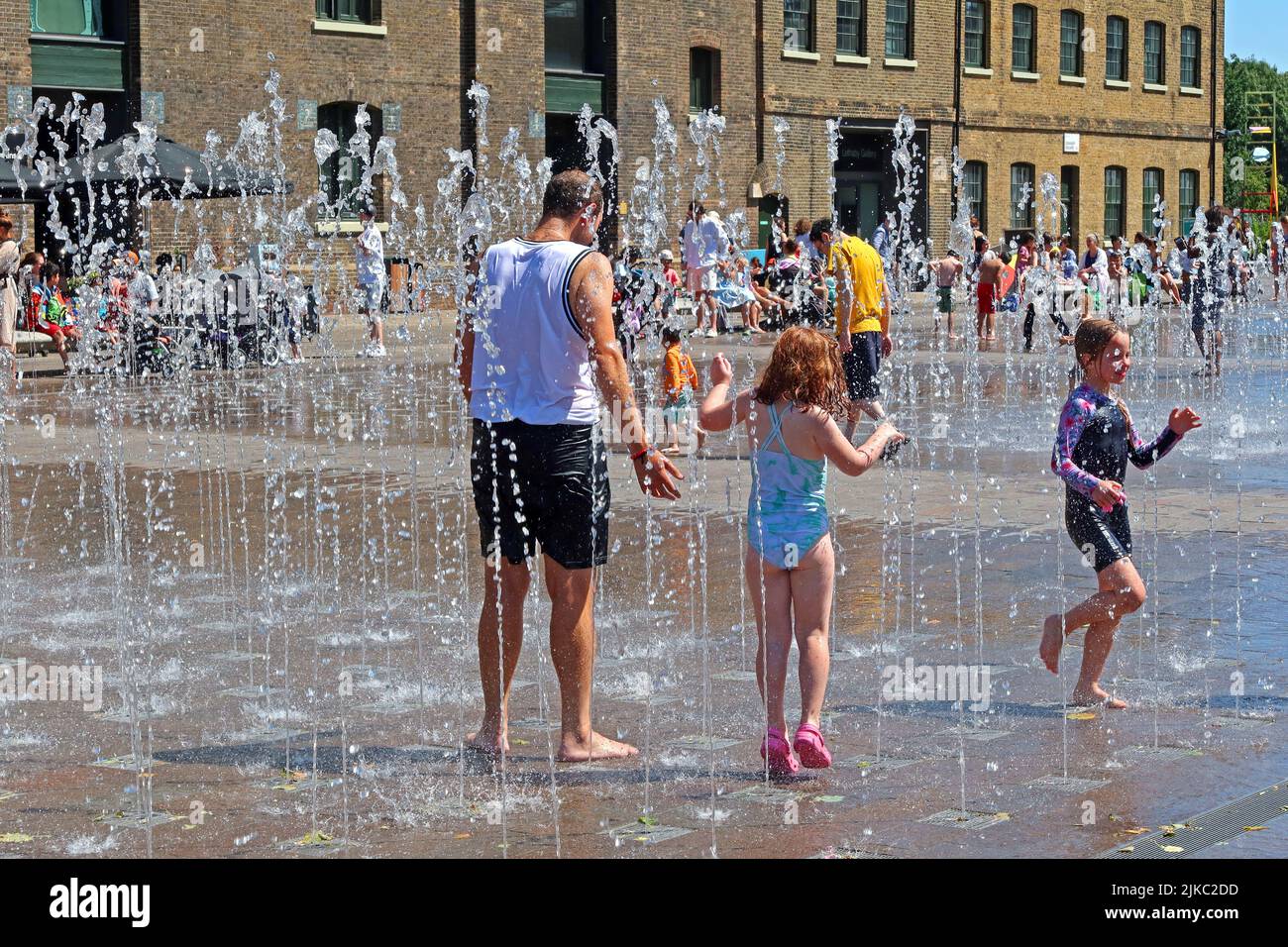
Families and children cool off among the choreographed splash fountains of Granary Square in King’s Cross, London, during intense summer weather. An adult and two young children stand barefoot in the water jets on the broad paved public square, with crowds, brick buildings and the regenerated urban setting visible behind them. The image captures both the enjoyment of hot weather and the practical use of interactive fountains as informal cooling spaces during periods of exceptional heat in the capital. The photograph is especially relevant to the late June 2026 heatwave affecting London, the wider United Kingdom and much of Europe. Britain provisionally reached 36.7°C at Merryfield, Somerset, on 25 June, setting a new national June temperature record for a second consecutive day, while the Met Office issued a Red Warning for Extreme Heat for a record third consecutive day. Across western and central Europe, a persistent blocking pattern, widely described as a heat dome or omega block, brought prolonged, dangerous temperatures and major impacts on health, infrastructure, labour productivity and daily life. Granary Square is well known for its large field of choreographed fountains and is a popular place for children and families in warm weather. In editorial terms, the scene works strongly for stories about public behaviour during heatwaves, urban design, city resilience and the adaptation of public spaces to hotter summers. Splash fountains, shade, drinking water access and other cooling features are increasingly important in dense cities where hard surfaces and the urban heat island effect can make temperatures feel even more oppressive. The image also connects with the broader climate emergency. Individual heat events arise from specific weather patterns, but human-caused climate change driven by fossil fuel burning is increasing the likelihood and intensity of extreme heat. The photograph therefore illustrates not only family leisure in London but also socity