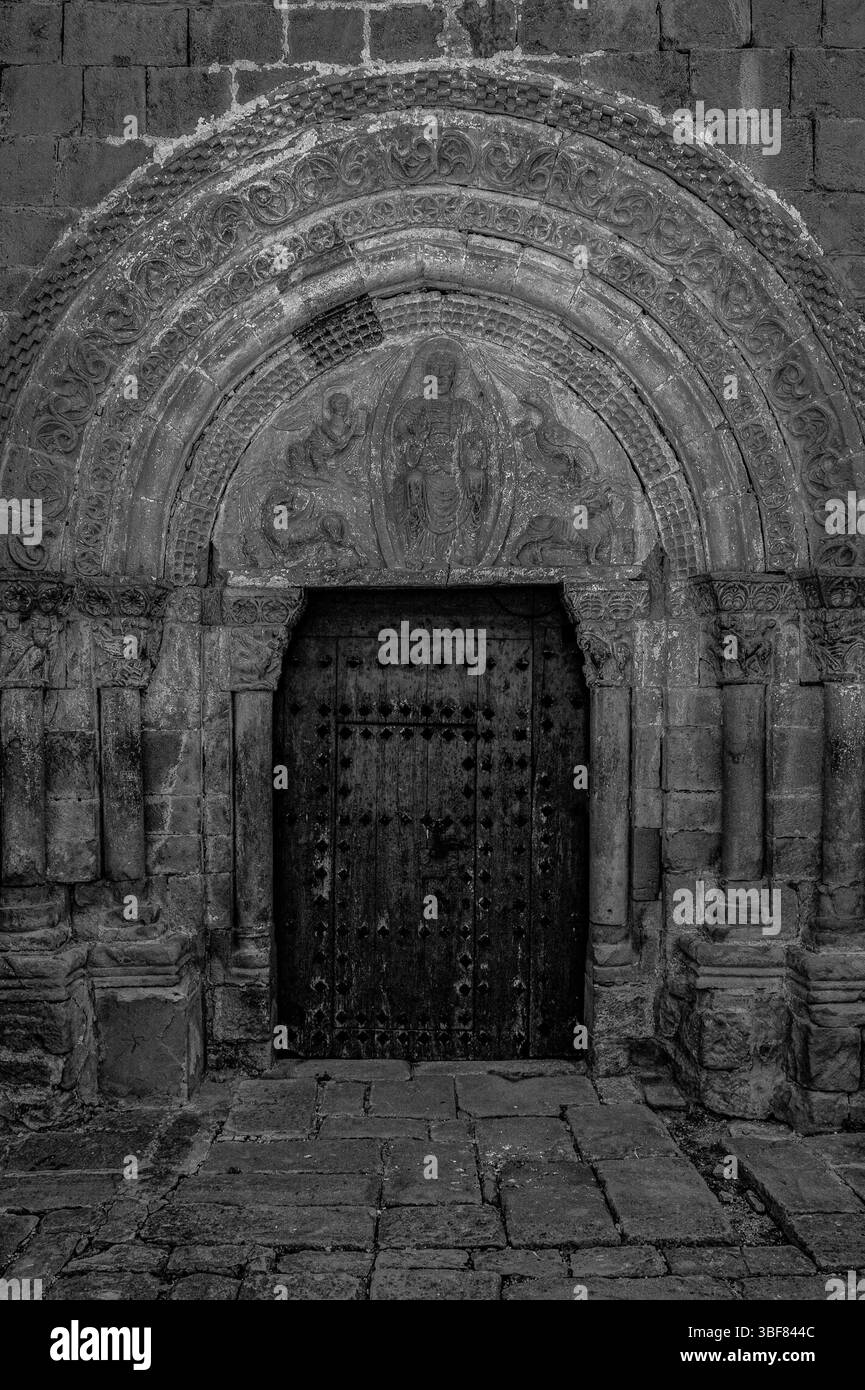
Spanisches romanisches Nordportal der Kirche San Salvador in Agüero, Provinz Huesca, Aragon, Spanien. Über einer alten, mit Eichengestöcken versehenen Tür ist Christus in Majestät oder Maiestas Domini, flankiert von Symbolen der vier Evangelisten, auf einem Tympanon abgebildet. Über dem Tympanon befinden sich vier dekorierte Archivolte, die auf engagierten Säulen ruhen, die von dekorierten Kapitellen überragt werden. Die Skulptur des Portals aus dem 12. Jahrhundert n. Chr. wird dem Meister von Agüero zugeschrieben.
2832 x 4256 px | 24 x 36 cm | 9,4 x 14,2 inches | 300dpi
Aufnahmedatum:
13. Juni 2011
Ort:
Church of San Salvador, Agüero, Huesca Province, Aragon, Spain
Weitere Informationen:
Dieses Bild kann kleinere Mängel aufweisen, da es sich um ein historisches Bild oder ein Reportagebild handel
Agüero, Huesca Province, Aragon, Spain: Romanesque north portal of the Iglesia or Church of San Salvador. Above an ancient studded oak door is a sculpted tympanum and decorated archivolts, resting on engaged columns with richly carved capitals. The portal’s sculpture, dated to the 12th century AD, is attributed to a sculptor known as the Master of Agüero. Sculpted on the tympanum is Christ in Majesty or Maiestas Domini, flanked by the traditional symbols of the Four Evangelists (clockwise from lower left): winged lion (St Mark); angel or man (St Matthew); eagle (St John); and ox or bull (St Luke). Jesus sits within a shallow recess framed by an oval mandorla, his right hand raised in a gesture of blessing while his left hand holds a book. The folds of the garment draped over his knees are carved with great skill. The tympanum and archivolts rest on engaged columns with capitals richly carved with scenes such as a man being pecked by two birds, two conjoined lions with a single head, a harpist and a female dancer with free-flowing hair. Scattered on the sculpture are remnants of ancient paint. The original medieval Church of San Salvador had a Romanesque barrel-vaulted nave and a semicircular apse. It was enlarged in the 1500s and 1600s, mainly in Late Gothic style, with new side aisles, star-shaped ribbed vaults and a round-arched clerestory. Renaissance pillars and a crypt were added inside and the church also gained a landmark campanile or bell tower. Seen from afar, the small town of Agüero is dwarfed by the spectacular sugar loaf rocks of Los Mallos de Agüero (The Mallets or Ninepins of Agüero). The dramatic formation of reddish Tertiary period rock, sculpted into vast pillars by erosion, towers 275m or 900 ft above the village. D1012.B2169.B