4750 x 3563 px | 40,2 x 30,2 cm | 15,8 x 11,9 inches | 300dpi
Aufnahmedatum:
26. März 2008
Ort:
Caracas Venezuela
Weitere Informationen:
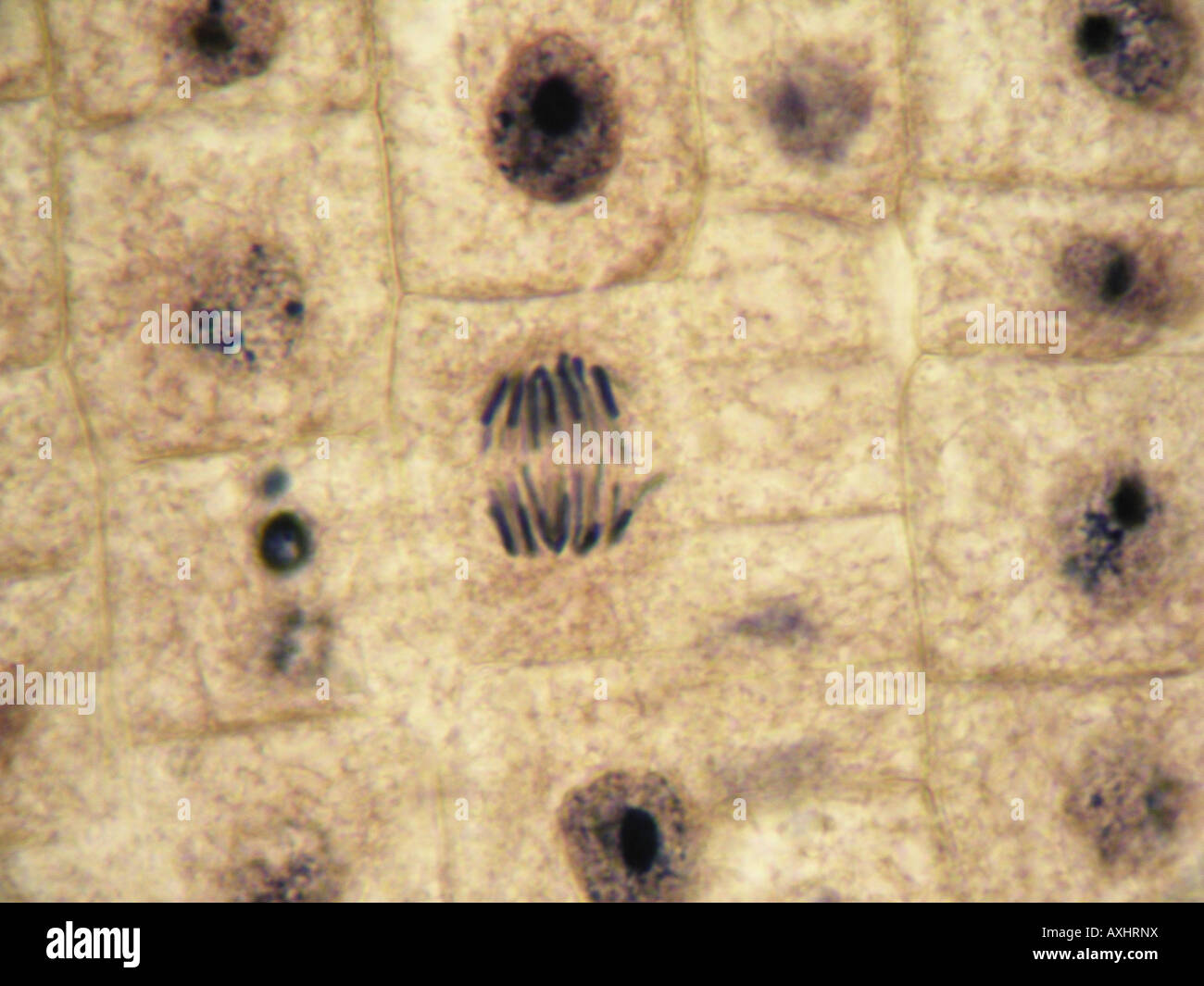
Cellular division mitosis in onion cells. Mitosis is the process by which a cell duplicates the chromosomes in its cell nucleus, in order to generate two, identical, daughter nuclei. It is generally followed immediately by cytokinesis, which divides the nuclei, cytoplasm, organelles and cell membrane into two daughter cells containing roughly equal shares of these cellular components. Mitosis and cytokinesis together define the mitotic (M) phase of the cell cycle, the division of the mother cell into two daughter cells, each with the genetic equivalent of the parent cell. Mitosis occurs exclusively in eukaryotic cells, but occurs in different ways in different species. For example, animals undergo an "open" mitosis, where the nuclear envelope breaks down before the chromosomes separate, while fungi such as Aspergillus nidulans and Saccharomyces cerevisiae (yeast) undergo a "closed" mitosis, where chromosomes divide within an intact cell nucleus.[2] Prokaryotic cells, which lack a nucleus, divide by a process called binary fission. The process of mitosis is complex and highly regulated. The sequence of events is divided into phases, corresponding to the completion of one set of activities and the start of the next. These stages are prophase, prometaphase, metaphase, anaphase and telophase. During the process of mitosis the pairs of chromosomes condense and attach to fibers that pull the sister chromatids to opposite sides of the cell. The cell then divides in cytokinesis, to produce two identical daughter cells.