2790 x 4200 px | 23,6 x 35,6 cm | 9,3 x 14 inches | 300dpi
Aufnahmedatum:
4. Dezember 2009
Ort:
Monterey Bay Aquarium, Monterey, California, USA
Weitere Informationen:
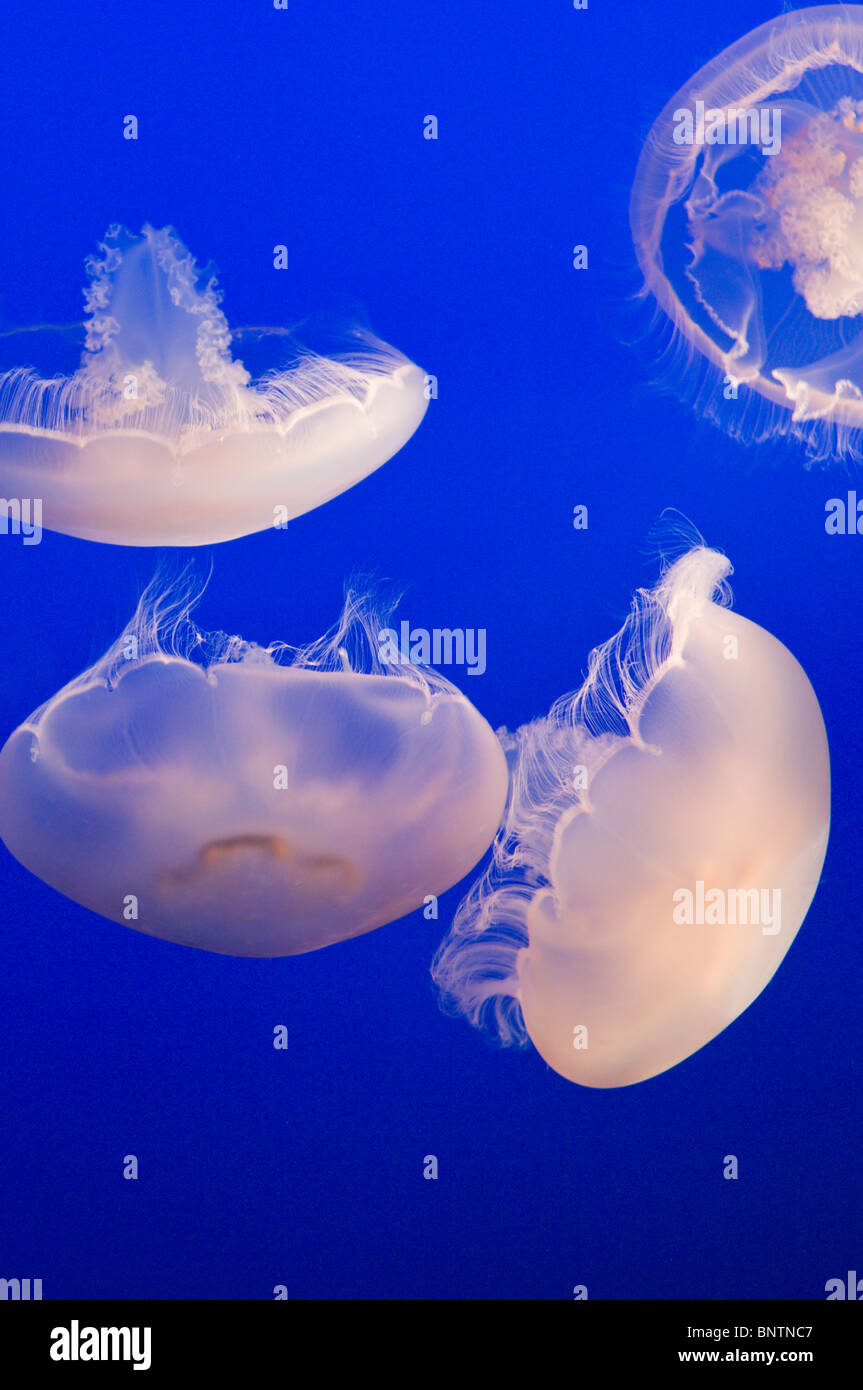
These alien-looking creatures are is named for its their translucent, moonlike circular bells. Instead of long, trailing tentacles, moon jellies have a short, fine fringe (cilia) that sweeps food toward the mucous layer on the edges of the bells. Prey is stored in pouches until the oral arms pick it up and begin to digest it. The coloration of a moon jelly often changes depending on its diet. If the jelly feeds extensively on crustaceans, it turns pink or lavender. An orange tint hints that a jelly’s been feeding on brine shrimp. Scientists have studied the life cycle of this jelly extensively. They know the adult male moon jelly releases strands of sperm, which are ingested by female moon jellies. After fertilization, larvae settle on or near the seafloor and grow into polyps. Polyps alternate between feeding and reproductive stages for up to 25 years. In the reproductive phase, polyps launch buds of cloned juveniles, known as ephyrae, which grow into adult medusae. Found worldwide in temperate and tropical waters, moon jellies feed in quiet bays and harbors. Although moon jellies have a sting, they pose little threat to humans.
Ausschließlich für die redaktionelle Nutzung freigegeben.
Verwendung im Zusammenhang mit Nachrichten berichterstattung, Rezensionen und Kritik sowie der Übermittlung von Informationen über Personen, Orte, Dinge, Ereignisse oder Geschehnisse.
Zur Klarstellung: Die redaktionelle Nutzung umfasst keine Nutzung im Zusammenhang mit Werbung, Verkaufsförderung (z. B. verkaufsfördernde Webseiten), Marketing, Verpackung oder Merchandising.