8000 x 5056 px | 67,7 x 42,8 cm | 26,7 x 16,9 inches | 300dpi
Aufnahmedatum:
30. Juni 2025
Ort:
Abbey Street Lower, Dublin 1, Republic of Ireland
Weitere Informationen:
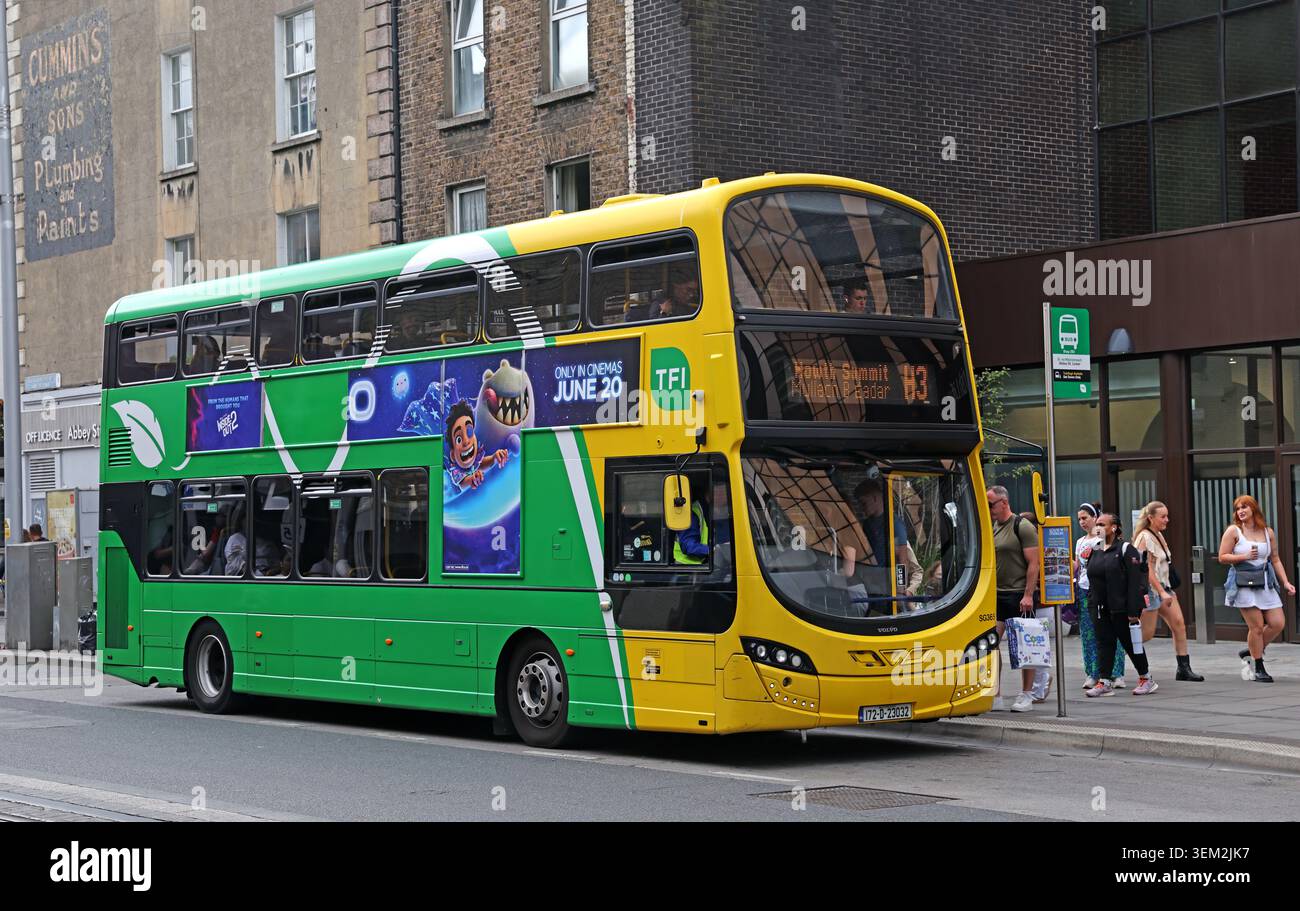
Green and yellow Transport for Ireland double-decker bus operates route H3 on Abbey Street Lower in Dublin city centre. The vehicle is pictured at the kerb beside waiting passengers, with shops, offices and older commercial buildings forming the urban backdrop. Its destination display identifies the H3 service towards Howth Summit, while the TFI livery presents a unified identity for publicly supported transport across Ireland. An advertisement across the upper deck adds colour to this everyday city street scene. Route H3 links Lower Abbey Street with Howth Summit through north-eastern Dublin, serving Fairview, Killester, Raheny, Bayside, Sutton and Howth. It forms part of the H-Spine introduced under the BusConnects redesign in June 2021. Together with routes H1 and H2, the spine provides a frequent shared service along the Howth Road corridor before the branches divide for Baldoyle, Malahide and Howth. This structure is designed to simplify the network, improve connections and provide regular access to the city centre. Dublin's bus system helps reduce dependence on private cars while carrying commuters, residents, students and visitors across the metropolitan area. Integrated TFI branding, Leap fares, real-time passenger information and connections with Luas, DART and national rail services support a more joined-up public transport network. Bus priority measures and fleet renewal are also central to plans for faster, more reliable and lower-emission urban travel. Ireland is progressively introducing battery-electric and low-emission buses to replace older diesel vehicles, improving local air quality and reducing transport emissions. This photograph is suitable for editorial coverage of Dublin transport, BusConnects, sustainable mobility, public investment, city-centre traffic, integrated ticketing, commuting, tourism, urban air quality, fleet modernisation and the transition towards cleaner public services