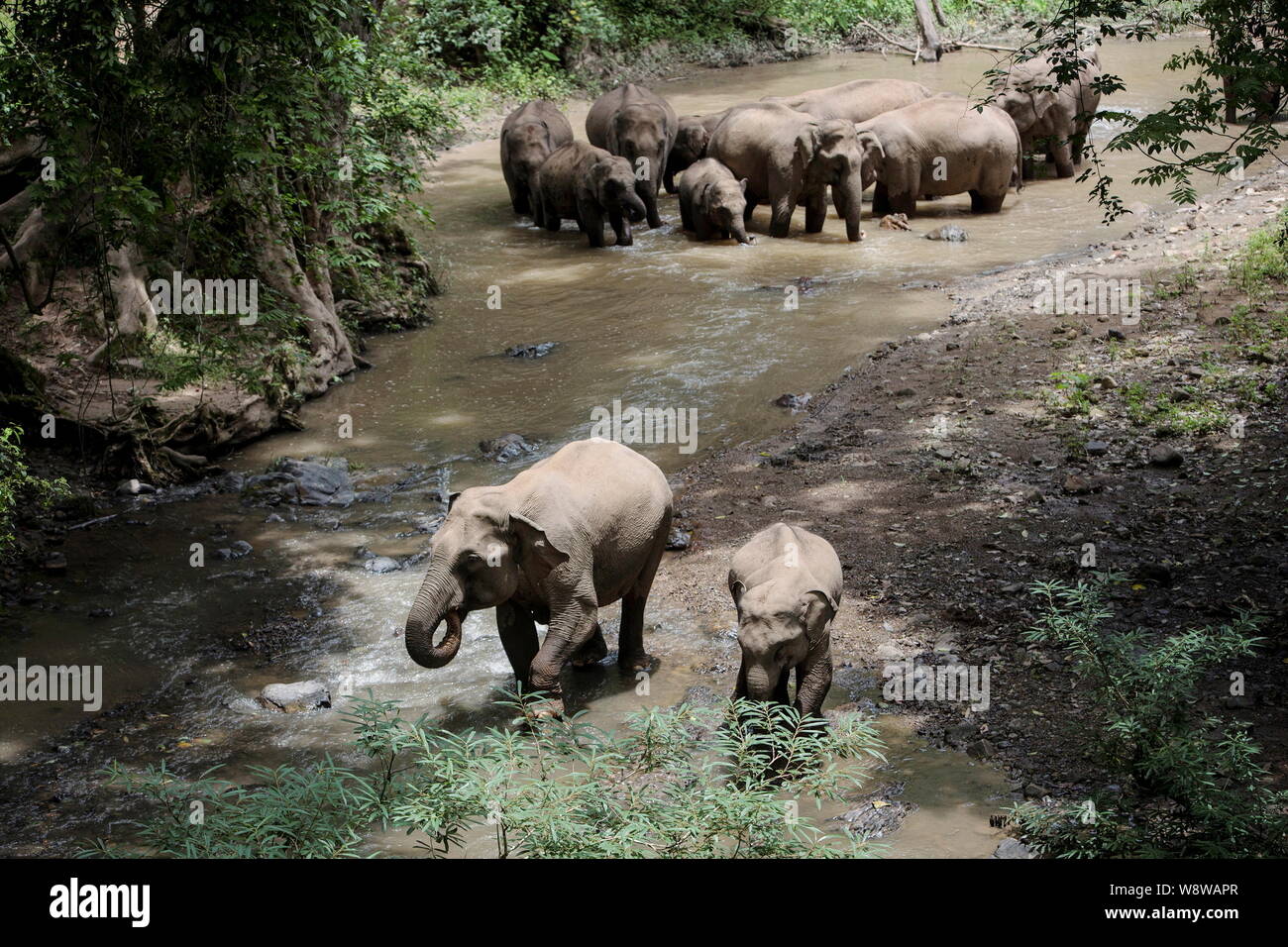
Wilde Elefanten haben sie Spaß in einem Fluss im Wilden Elephant Valley in Hangzhou City, Xishuangbanna Dai Autonomen Präfektur, Southwest China Yunnan prov
Wild elephants have fun in a river in the Wild Elephant Valley in Jinghong city, Xishuangbanna Dai Autonomous Prefecture, southwest Chinas Yunnan province, 21 June 2014. At a time when tens of thousands of elephants across Africa are being slaughtered to feed the Chinese appetite for ivory, it turns out the best place to be a wild elephant may be here in the tropical forests of southwest China. Over the past two decades, the number of Asiatic elephants in Yunnan Province in China has roughly doubled, to nearly 300, thanks to government-financed feeding programs, wildlife education efforts and a strict elephant protection law unmatched anywhere else in the world. Convicted poachers in China face the death penalty. Elephants have it pretty good here because it is safe and there is plenty to eat, said Chang Zongbo, a local forestry official. Once the elephants cross the border from Laos, where hunting is allowed, they never want to go back. The biggest threat they face in China is loss of habitat. With Yunnans forests rapidly giving way to rubber and other cash crops, the countrys half-dozen or so elephant families have become marooned in disconnected preserves. Zoologists say the inability to breed with other herds threatens the elephants genetic diversity, leaving them vulnerable to disease. At the same time, the regions growing human population has led to a surge in conflicts between man and beast, some fatal. Who does not love the elephant? said Xiong Qiaoyong, 30, a ranger at the Wild Elephant Valley, a popular nature park on the outskirts of Jinghong that draws thousands of visitors a day. Although 16 to 24 elephants are said to live in the 900-acre preserve, most encounters between man and beast take place in a dusty circus ring, where visitors enjoy $5 elephant rides or watch a pack of world-weary performers stand on their hind legs and dutifully place hats and scarves on the heads of petrified audience members. But neither public fondness for elephants nor d