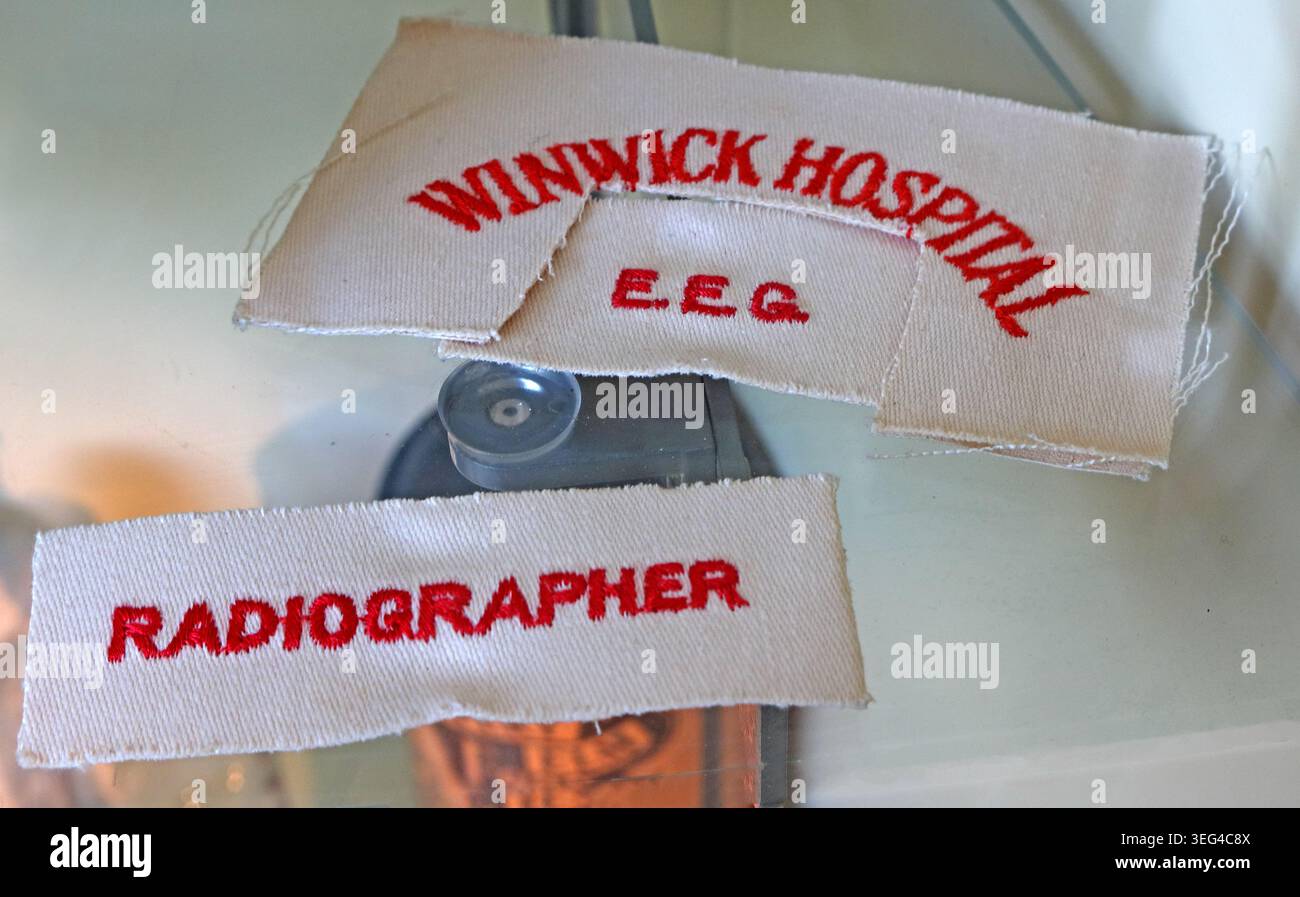
Winwick Hospital EEG- und Radiografen-Uniformabzeichen, Erinnerungsstücke aus dem ehemaligen psychiatrischen Krankenhaus in der Nähe von Warrington, England, UK.
5240 x 3256 px | 44,4 x 27,6 cm | 17,5 x 10,9 inches | 300dpi
Aufnahmedatum:
2. Mai 2026
Ort:
Former Winwick Hospital site, Hollins Lane, Winwick, Warrington, Cheshire, England
Weitere Informationen:
Embroidered staff uniform badges preserved as memorabilia from the former Winwick Hospital near Warrington, Cheshire, England. The white fabric labels carry red lettering reading “Winwick Hospital EEG” and “Radiographer”, representing specialist diagnostic services once provided within the large psychiatric hospital. EEG is an abbreviation for electroencephalography, a procedure used to record electrical activity in the brain. The radiographer badge relates to medical imaging work carried out by trained hospital staff. Together, the surviving textile labels provide a small but evocative record of the clinical departments, occupations and professional identities associated with the institution. Winwick Hospital began as the Fifth Lancashire County Asylum and opened in 1902. During the First World War, the site was transferred to military use and became the Lord Derby War Hospital, treating injured service personnel. It subsequently became Lancashire County Mental Hospital and joined the newly established National Health Service in 1948 under the name Winwick Hospital. The hospital occupied an extensive site west of Winwick village, close to Hollins Lane. Like many large British psychiatric institutions, its role changed during the twentieth century as treatment practices evolved and services moved increasingly towards smaller hospitals and community-based care. Displayed as historic medical memorabilia, the badges are relevant to editorial coverage of psychiatric healthcare, county asylum history, NHS heritage, radiography, neurological diagnosis, hospital employment, medical uniforms and the preservation of local social history. They also illustrate how modest personal and occupational objects can document the everyday working life of a major institution after its closure.