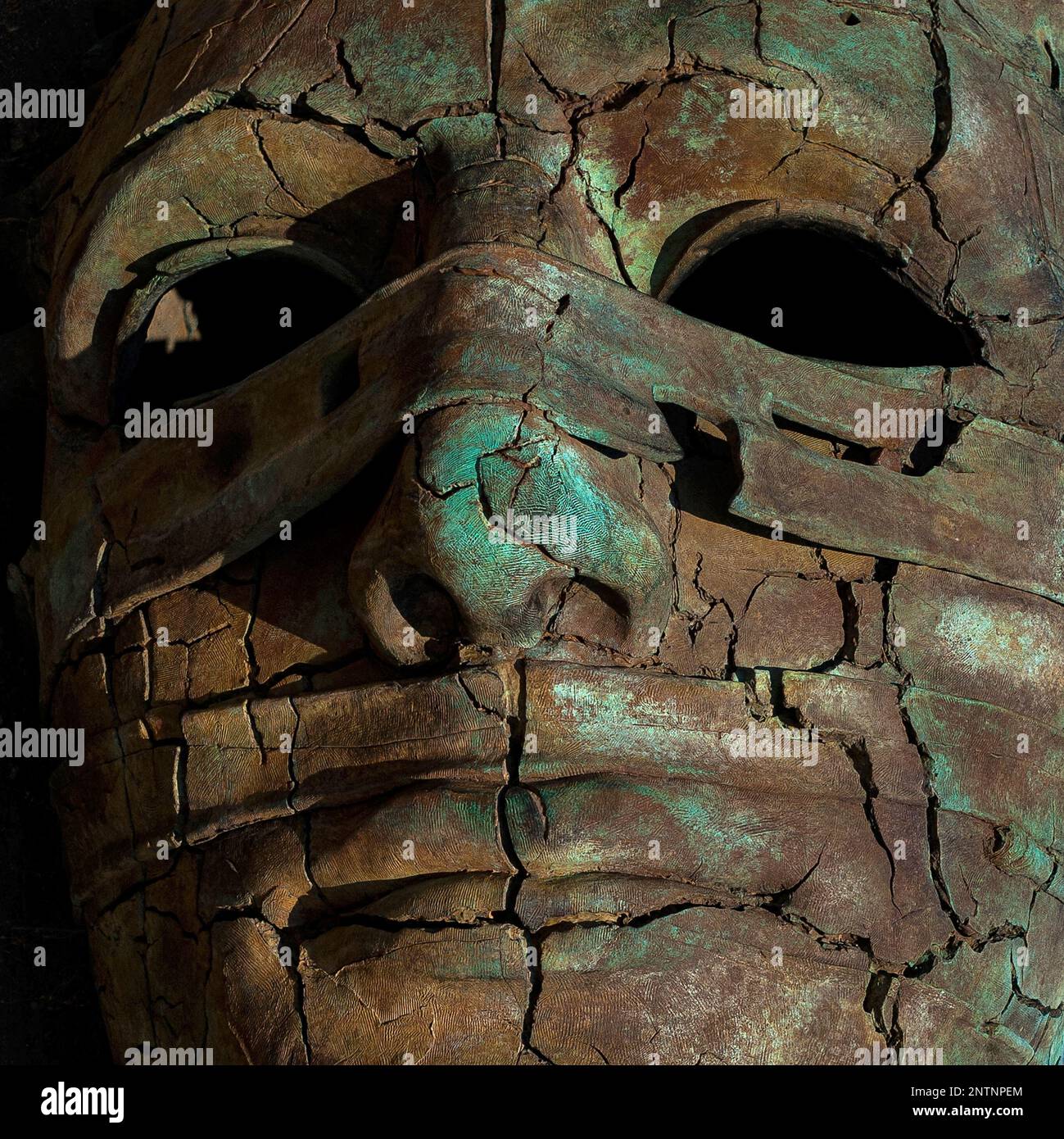
Zerrissene Bronzeseite von Eros Bendato Screpolato (Eros mit den Augen verbunden und gerissen) des polnischen Bildhauers Igor Mitoraj (1944–2014) im Templi-Tal in Agrigento, Sizilien, Italien.
2729 x 2730 px | 23,1 x 23,1 cm | 9,1 x 9,1 inches | 300dpi
Aufnahmedatum:
19. August 2011
Ort:
Valley of the Temples, Agrigento, Sicily, Italy
Weitere Informationen:
Dieses Bild kann kleinere Mängel aufweisen, da es sich um ein historisches Bild oder ein Reportagebild handel
Agrigento, Sicily, Italy: detail of Eros Bendato Screpolato (Eros Blindfolded and Cracked) by world-renowned Polish sculptor Igor Mitoraj (1944-2014), amid the ruins of the ancient Graeco-Roman port city of Akragas or Agrigentum at the Valley of the Temples or Valle dei Templi UNESCO World Heritage Site. This vast bronze head of the Ancient Greek god of love and desire lay on its side at the Valley of the Temples from 2011 to 2013. The artwork is an alternative casting of the 1999 (smooth-surfaced) Eros Bendato sculpture in the Main Square at Krakow, Poland. Other versions, sometimes translated as Eros Bound, have been displayed around the world. Igor Mitoraj was one of Poland’s most acclaimed sculptors. He specialised in large-scale fragmented human bodies, emphasising their fragility and illustrating how antiquity degrades over time. Eros Bendato, a disembodied head wrapped in bandages, is also been seen as a comment on human suffering and as a suggestion that love might well be blind, with the targets of Eros’s arrows selected at random. Akragas was founded circa 580 BC by Greek colonists. It expanded rapidly, becoming a rich leading city of Magna Graecia (Greater Greece) before it was sacked by the Carthaginians in 406 BC. It never regained its former status and in the Punic Wars between Rome and Carthage, it changed hands several times. Rome finally triumphed, renamed it Agrigentum and allowed its people to become Roman citizens. When the Western Roman Empire fell, Agrigentum was ruled in turn by Vandals, Ostrogoths, Byzantines, Saracens and Normans. Akragas covered a vast area, much of it not yet excavated. Its seven monumental Doric temples are among the largest and best-preserved ancient Greek buildings outside of Greece itself. D0544.A6504.B